
The Council of Scientific & Industrial Research (CSIR) is a premier Research & Development Organization in India, established by the Government of India in the year 1942 as an Autonomous Body registered under the Society’s Registration Act XXI of 1860. The Prime Minister of India is the President of the Society (CSIR). The primary objective of CSIR was to Achieve Self-Reliance in the field of Science & Technology by way of providing all-round assistance in implementing the concept of industrialization in the country and harnessing the vast resources of India in eradicating hunger, poverty and unemployment. With the advent of independence, the expansion of the CSIR started, wherein around 40 different National Labs/Institutes were established all across the country in order to perform R&D in all the areas ranging from Agriculture to Aeronautics. In the last 75 years, the CSIR registered a colossal growth in terms of manpower, money and material. The Annual Budget of CSIR which was Rs.5.00 Lakhs in 1942 rose to around Rs.4000 Crores in 2017. The scientific, technical and administrative manpower employed in CSIR (covering all labs/institutes) had exceeded to more than 25,000 in 1986-87; and unfortunately due to various policies of Government of India the manpower has dwindled to around 16,500 in 2017.
The varied socio-economic policies of Government of India had kept this premier R&D organization delinked from the industrial & economic activities of the country during 1980s and 1990s. The CSIR became a hot bed of power & career games, misuse & abuse of power, nepotism, scientist-bureaucrat cliques & counter cliques. Even today, the CSIR has different sets of rules for different categories of staff which are arbitrary and discriminatory. Before the implementation of 60 years retirement age for all CG employees (in 1998), the Scientists & other employees belonging to S&T use to retire at 60 years and others at 58 years. In the name of decentralization of power, the Heads of all these 40 National Labs have been vested with immense power making them Monarchs of their domains.
In the initial stages of CSIR, Trade Unions formed at a few labs/institutes were not recognized by CSIR. In the later part of 1950s the vicious atmosphere of the National Laboratories went on unabated. In such a situation, isolated voices of dissent were strangled ruthlessly (Even now in a few laboratories the same is the case – Particularly in CFTRI during the regime of Prof. Ram Rajasekharan). Workers of almost all the National Laboratories started reacting against this situation and in many Labs/Institutes, efforts were made to organize the workers in several ways. Subsequently, Unions and Associations (as per Indian TU Act 1926) were formed in 2-3 National Labs during this period. In the later part of 1960s, the event took a dramatic turn. A number of Unions and Associations were formed in many Labs and they openly confronted the authorities by way of registering themselves under Indian TU Act of 1926. This was a major break-through since this step helped the workers to gain their Trade Union Rights, the first step forward in their fight against the Dictatorial Authorities.
After witnessing all these, the Heads of the National Labs/Institutes unleashed a reign of terror by indulging in a policy of victimization of Trade Union leaders and activists. As a result, the services of a number of TU leaders and workers of CEERI-EU (Pilani), CMRS-EA (Dhanbad), RRL-EA (Bhubaneshwar), NML-EA (Jamshedpur), IIP (Dehradun), etc. were terminated. A number of suspension Orders were also issued to the Trade Union leaders of BITM-EA (Calcutta), NML-EA (Jamshedpur), CEERI-EU (Pilani), etc. One strong aspect of this phase of struggle was that the onslaught of the Authorities could not break the morale & spirits of the workers, and formation of the employees/workers Unions & Associations went on during this period. The weaker aspect of this phase of struggle was the lack of consolidation and coordination in the movements of Unions & Associations of different Labs/Institutes, although the Authorities of different Labs were united in their anti-labour activities.
Experience of all the events of 1950s and 1960s were an eye-opener to some conscientious & sincere leaders of the Unions & Associations. They felt that a lone fight against a powerful and organized bureaucracy would be suicidal. Keeping in view this aspect, in the year 1967, there were a few exchanges of views between some of the leaders of National Laboratories, which unfortunately turned out to be a damp squib. Hence, the attempt for a united movement could not materialize at that time. However, a new ray of hope again came with the formation of Unions & Associations in Calcutta and Durgapur during the year 1967-68. During the years 1969 & 1970, the representatives of CGCRI-EU, IIEM-EA, CMERI-EA and NML-EA held joint meetings in Calcutta on 18.12.1969 and Jamshedpur on 9.2.1970 respectively. After establishing contacts with some more Unions & Associations of National Labs, another Joint Meeting of the representatives of the above and those of BITM-EA (Calcutta), CPHERI (NEERI)-EU (Nagpur), and CEERI-EU (Pilani) was held in Durgapur on 19th March 1970, and a Joint Committee of Unions & Associations of National Laboratories was formed to achieve the following objectives :
The first ever Joint Protest of CSIR Employees/Workers comprising of CGCRI-EU, IIEM-EA, BITM-EA, CMERI-EA and NML-EA was observed from 19.02.1970 to 21.02.1970 against the suspension orders issued to the then President and General Secretary of NML-EA. But the first united movement was launched in April 1970 under the banner of the Joint Committee against the suspension orders issued to the then General Secretary of BITM-EA. As a part of the movement, a joint procession of the employees of CGCRI, IIEM, BITM, NML and CMERI was organized and a Memorandum was handed over to the Governor of West Bengal in protest against the illegal suspension order.
The Joint Committee after working for about 8 months again met at Nagpur on the 14th and 15th November 1970 to concretize its programme in order to achieve the objectives, where except CEERI-EU, all the members of the Joint Committee participated. It was agreed upon in the meeting that all efforts would be made to organize Unions & Associations in different National Laboratories on priority basis so that the much needed Federation of CSIR Employees was formed within a short period.
As a sequel to the decision of the Nagpur meeting, the Joint Committee leaders started organizing Unions & Associations in different National Laboratories. As a result, during the year 1971 and the first 3 months of 1972, a number of Unions & Associations were formed in different National Labs under the guidance of the Joint Committee. Since the newly formed Unions & Associations were eager to take part in the activities of the Joint Committee, another meeting of the Joint Committee was convened at Dhanbad from 12th to 14th May 1972 to consider formation of the proposed Federation of CSIR Employees & Workers, where the following Unions & Associations participated :
CGCRI-EU, IIEM-EA, BITM-EA (Calcutta); CMERI-EA (Durgapur); NML-EA (Jamshedpur); RRL-EA (Bhubaneswar); CPHERI-EU (Now NEERI-EU) (Nagpur), CSIR-WU-NPL Unit (New Delhi); RRL-NGOs A (Hyderabad); CMRS-EA, CFRI-EA (Dhanbad).
After a series of deliberations for 3 days in CMRS and CFRI (Dhanbad), the Federation of CSIR Employees’ & Workers’ Unions and Associations was formed – Later during the ending days of Federation, the same was renamed as All-India Association of CSIR Employees (on 23.02.2002 in the Enlarged WC meeting of Federation held at Hyderabad) in a bid to seek recognition from CSIR as per CCS(RSA) Rules-1999. But even after this, the CSIR did not accord Recognition as per these undemocratic rules.
In the initial meetings prior to the formation of the Joint Committee, only 4 units viz. CGCRI-EU, IIEM-EA, NML-EA and CMERI-EA were moving together. In Durgapur meeting, it rose to 8 with the joining of CPHERI-EU, RRL-EA, CEERI-EU AND BITM-EA, and then onwards the number went on increasing. In the year 1973, when the first Annual Conference of the Federation was held in Delhi, the figure of affiliated units of Federation was 17. As on 1987, the Federation had 29 affiliated units and 2 Associated Units (NCL-EA, Pune and NAL Workers Welfare Association, Bangalore). As on 2000 (the year in which Federation was de-recognized), there were 38 Affiliated Units out of the 40 Labs/Institutes of CSIR. The Associated Units were not given the Certificate of Affiliation since they did not conform to the Bye-Laws of Federation – the President of NCL-EA being an outsider who had allegiance to Bharat Mazdoor Sangh and the President of NAL-WWA being the Director of NAL.
Such was the period during 1960s and mid-1970s that the employees who were keen to form Unions/Associations and Central Federation, used to meet very secretly so that the Management officials did not see them. When these employees/representatives go out of stations for meeting, they used to stay in Dharmashalas and sometimes sleep in Railway Stations, Temples, etc. Meeting used to be held in Dharmashalas and sometimes underneath the trees. A fear syndrome existed during those days. Only after 1979, things changed a little bit, and the Federation and its affiliated units were officially accorded de facto recognition.
The Federation firmly believed that isolated movement of the CSIR employees for basic and common demands can never lead to any success unless supported by the broader section of the working class of the country. Therefore, the CSIR employees, under the leadership of the Federation always kept close contacts with the mainstream and participated in the Joint Movements of the Working Class of the Country against any move of the Government of India for curtailment of Democratic and Trade Union rights.
Although the CSIR authority did not fully recognized the Federation (only de facto) till its oblivion (end), the CSIR was compelled to sit across the table with the representatives of the Federation from 1979 onwards, which was mainly due to the impact of the movement. After a strong and continuous movement of the Federation during October-November 1979 before the CSIR Headquarters, the CSIR authorities started negotiating/dealing with the Federation representatives officially, even without granting formal recognition to it.
Till the end of Federation, its representatives consolidated their gains and maintained the fighting spirit by keeping a constant vigil. In the late 1980s and 1990s the representatives of Federation as well as its affiliated units launched various protests and movements in order to achieve the outstanding basic and common demands of CSIR employees and also against the major threats like (a) the move of the Government to curtail all democratic and trade union rights (which the Government ultimately did by introducing the pro-management and anti-employees CCS(RSA) Rules-1993 in 1999); (b) the motivated campaign by the Policy Makers of the country questioning the productivity of the National Laboratories which was posing a serious threat to the very existence of the CSIR organization.
Besides the Federation bargaining for their monetary, promotional & other benefits, it also continuously deliberated on the socio-economic policies of the GoI and CSIR policies with reference to the high impact on CSIR setup. It used to, time and again, provide constructive inputs to CSIR Management on these aspects. In 1980s & early 1990s it had deep concern on the GoI’s policies wherein the country had to depend more and more on foreign aid & technical knowhow for industrial growth despite the impressive infrastructure and large increase in resources for science & technology; and the apathy and indifference of the Government and entrepreneur and also lack of initiative on the part of CSIR authorities have thus led to an alarming penetration of foreign technology in Indian industries.
It may be noticed that the experiences of Com. B.K. Roy & other founder members of Federation, was very well brought out in the Article published in the Souvenir of Federation Annual Conference, from where the origin, struggle, etc. has been emphasized in this website. Mr. BK Roy in his Article had elaborated the structure, etc. of CSIR, the atmosphere prevailing therein during 1950s and 1960s, the attitude of the CSIR Authorities/Head of the National Laboratories towards the CSIR employees in general. It has also been mentioned therein as to why, how and when the employees and workers of CSIR, stationed in different National Labs were compelled to organize themselves, form their respective Unions/Associations and thereafter formed the Joint Committee. Com. Roy stressed openly for all the new-comers in the Federation leadership to realize the worst unfavourable conditions faced by the founder members of the Federation and the sacrifices made by the predecessors in organizing Trade Unions at different National Labs of CSIR by rendering their dedicated services and finally bringing them under the platform of this Federation.
The situation prevailing in the beginning had changed gradually and over a period of time, the atmosphere was completely different. In earlier days, any move to form a Union/Association was considered as a serious offence and was punishable under Service Conduct Rules. In most of the States, registration of Unions/Associations formed by the CSIR Employees was not permissible under TU Act. But later in 1980s, a Union/Association could have been formed even by a small group of employees of any National Laboratory and get the same registered under TU Act.
CSIR being a Society, registered under Society’s Registration Act, the relationship between the CSIR authorities and CSIR employees was “Master & Servant” in the eyes of law and as such CSIR employees were not allowed to avail of any legal protection under Article 226 of the Indian Constitution which otherwise was admissible to Central Government employees, even though their service conditions were also guided by the service conduct rules as propounded by GoI. At a later stage even when a considerable number of the Unions/Associations of CSIR employees/workers were registered under TU Act, they were denied legal justice in the Labour Court under Industrial Disputes Act on the plea that the CSIR is not an Industry.
After the historical judgement of the Supreme Court delivered by Hon’ble Justice Krishna Iyer, clarifying the definition of “Industry”, the CSIR came under the purview of Industry. After this, the CSIR employees started fighting their cases in the Labour Court under Industrial Disputes Act.
Due to continuous pressure from the CG employees through JCM as also due to the pressure made by the Central TU Organizations and MPs belonging to Opposition Parties, the GoI constituted Central Administrative Tribunal (CAT) during 1980s, through which the CG employees were able to get some legal justice on service matters within a short period of time. As per the continuous Demand of the Federation, the CSIR authorities extended the benefit of CAT to the CSIR employees in 1984. It was pleasing that most of the judgements of the Labour Court in respect of the disputes of the CSIR employees were delivered in favour of the employees. In a number of cases, the CSIR employees were awarded judgements in their favour by the CAT.
Prior to the formation of the Joint Committee/Federation, services of a number of CSIR employees who took initiative in organizing the employees in different National Laboratories or even tried to raise their voice of protest against injustice, were terminated without assigning any reason, against which even a protest movement could not have been organized in those days. Com. J. Roy of CSRS, Com. Melban of CEERI are the two such glaring examples. There are many such other cases of termination or victimization in other forms, records of which are not readily available. But after the formation of the Joint Committee/Federation against all cases of TU victimizations, strong voice of protest were raised and all form of movements were organized under the leadership of Joint Committee/ Federation, both at the laboratory level as well as before the CSIR HQs, which resulted withdrawal of almost all those cases of TU victimizations. Worth-mentioning cases are : (1) Withdrawal of suspension orders against Com. Sirajuddin and Com. Jabbar, President & General Secretary of NML-EA; (2) Withdrawal of suspension order against Late Com. P. Dey, GS, BITMEA; (3) Withdrawal of suspension order and disciplinary proceedings against Com. R.N.Lahiri & Com. D. Appa Rao, President and GS of NML-EA; (4) Revocation of termination order under Rule 5 against Com. R.C. Banerjee, Jt. Secy., NML-EA; (5) Withdrawal of suspension order and disciplinary proceedings against Com. S.B. Singh and Com. P.K. Bose, GS & Treasurer, CGCRI-EU; (6) Withdrawal of suspension order and also revocation of termination order against Com. Harimohan, GS, CSIR-WA; (7) Withdrawal of all cases of victimizations in CDRI by a written agreement signed jointly by the Director, CDRI and GS, Federation during 1978; (8) Withdrawal of all cases of TU victimizations for the Movement launched in CDRI during 1979-80 and financial and legal assistance to some fo the leaders of CDRI for fighting their cases in Labour Court; (9) Settlement of TU victimization in NBRI-Lucknow; (10) Settlement of disputes between RRL-Bhubaneswar authority and RRL-EA in more than one occasion resulting in withdrawal of mass scale victimizations in RRL, Bhubaneswar; (11) Withdrawal of suspension orders and disciplinary proceedings against Com. K.D. Sharma and Com. Tulsi Ram, President and GS, IIP-WA as also settlement of all cases of mass scale victimizations for the Movement launched by IIP employees during 1979-80; (12) Settlement of the dispute raised for payment of Remote Area Allowances to RRL-Jorhat employees, which otherwise would have resulted in a total confrontation and mass scale victimization; (13) Withdrawal of transfer orders of NEERI Employees posted at Calcutta Field Station; (14) Withdrawal of apprehended mass scale victimization in NEERI, Nagpur and settlement of the dispute; (15) Withdrawal of suspension order against Com. Ayub, President, IICT and settlement of other disputes; (16) Revocation of orders terminating the services of Com. Sinha, Com. Rahamathulla and Com. Thakur, President, Vice-President and GS of CMRS-EA; (17) Withdrawal of Lock-Out order issued by the BITM authority through an Agrement signed by BITM authority, representatives of BITM-EA and GS, Federation in presence of the Chief Secretary, Govt. of WB as also revocation of all orders of suspension issued against more than a dizen of BITM employees; (18) Absorption of all the surplus staff of DRL, Jammu, VITM, Bangalore and BITM, Calcutta in different National laboratories, due to delinking of those organizations from CSIR; (19) Conversion of termination order of TU leader of CSIR-WU-CRRI Branch into voluntary retirement with all retirement benefits, etc. etc. Inspite of best efforts, one or two cases of victimizations could not be settled to the best satisfaction of the Federation despite repeated negotiations. One such case was that of Com. Raj Sharma, one of the founder leader of IIP-WA. As negotiations with both IIP authority and CSIR Management could not bring any fruitful result, Com. Sharma filed his case in the Labour Court, which had given him some relief.
Till 1979, the CSIR authorities were reluctant to grant recognition to the Federation and to negotiate with the Federation officially. But, due to continuous struggle and movement launched by the CSIR employees both at laboratory level as well as before the CSIR HQs during 1974, 1977, 1978 and 1979, the CSIR authority started negotiating with the Federation officially from the later part of 1979. Even before such official negotiation, both the DGCSIR and Heads of the National Labs. were compelled on a number of occasions to negotiate with the Federation representatives as well as with the representatives of the local Unions/Associations as and when the action Movement of the CSIR employees drew support from the broader section of the workers, especially when the Central Government employees rendered their active support. Similarly, where the Unions/Associations of the local labs. were strong enough, the Heads of the National Labs were compelled to negotiate with the Union/Association representatives.
From the later part of 1979 and onwards, both the Federation and its affiliated units were enjoying de-facto recognition. All the benefits which were being enjoyed by the recognized Federations/Confederations of identical nature, were also extended to the Federation and its affiliated units. The DGSIR was holding periodical meetings with the Federation for settlement of the disputes/problems/demands of the CSIR employees and similarly, the Heads of the National Labs were holding meetings with the representatives of the local Unions/Associations to settle the local problems as and when situation demanded.
It has already been mentioned earlier that in accordance with the Judgement of Hon’ble Supreme Court, Research Institutes, Educational Institutions, Hospitals, Charitable Organizations, etc. were brought under the purview of “Industry”. After the above judgement, employees of those organizations started knocking the doors of Labour Court for redressal of their grievances under ID Act. In order to deprive those sections of employees from getting the benefits of ID Act, the then Central Government decided to bring a Bill in the Parliament entitled “Hospital and other Institutions’ Settlement of Dispute Act” during the year 1979. Since this Bill was likely to deprive the employees of CSIR and other similar Organizations in realizing some relief under the provisions of ID Act, the Federation decided to organize the employees of Universities, Hospitals, Charitable Organizations, Research Institutes of ICAR, ICMR as also other isolated Research Institutions stationed in different parts of the country, in order to launch protest movement from the joint platform. For this purpose, a Joint Committee was formed, where the GS (Federation) was nominated as one of the Conveners. A number of protest meetings, seminars, etc. were organized in different parts of the country. With the united movement of the employees of Universities, Hospitals, Charitable Organizations, CSIR and also the employees of Research Institutions, etc. duly supported by the Central Trade Union Organizations, the Government of India had to withdraw the Bill unconditionally.
Broadly, the CSIR employees were earlier divided in five categories viz. (a) scientific, technical, auxiliary technical, administrative and class-IV (technical and non-technical). Prior to 1978, retirement age of the scientific and a section of technical employees was 60 years. As per GoI service conditions, the retirement age of the Class-IV employees was also 60 years. The retirement age of remaining CSIR employees was 58 years. As already mentioned earlier that strong movements both at lab level as also before the CSIR HQs. were launched during 1977, 1978 and 1979 which brought some favourable results. In 1978, the CSIR re-classified the CSIR employees. All the auxiliary technical employees of CSIR were declared as Technical and their retirement age was re-fixed from 58 years to 60 years. As a result, except the administrative staff, covering less than 10% of the total CSIR employees, retirement age of the remaining employees of CSIR was fixed at 60 years.
As per the recommendations of the Sarkar Committee, only the scientific staff of CSIR were getting the benefit of assessment promotion after every 5 years under CSIR Bye-Law 71(b). For other categories of CSIR employees, there was no career development scheme except DPC system of promotion as was followed in other CG Departments. For certain lower categories of CSIR employees, ie. Class-IV employees, such DPC system was not even admissible. As a result, many employees of CSIR had to stagnate in the same post till their retirement.
Being much aggrieved and annoyed with such conditions, the CSIR employees under the leadership of the Federation were compelled to show their strong resentment through sustained action movements both before the CSIR HQs as also in different laboratories/institutes in support of the following main demands of the CSIR employees during the years 1977, 1978 and 1979 :
Due to such a continuous movement of the CSIR employees duly supported by the broader section of the working people of India, the CSIR, as already mentioned earlier, declared the auxiliary technical employees of CSIR as technical and raised their retirement age upto 60 years. The technical employees of CSIR upto the category of JTA were brought under the purview of 5 yearly assessment promotions under Bye-law 71(b). In 1981, the CSIR agreed to grant assessment promotions to the remaining technical employees of CSIR through the scheme NRAS (Normal Recruitment and Assessment Scheme), popularly known as “Velluri Committee Recommendations” wherein, except the Administrative staff and Class-IV non-technical staff members, all other scientific and technical staff of CSIR were entitled for assessment promotion after every 7 years. For the Drivers and non-technical Class-IV employees of CSIR, some provisions were made in the scheme, ie. by inducting them into technical category they were entitled to enjoy the benefit of assessment promotion. For the administrative staff, though no such scheme was introduced but in order to remove stagnation, a formula of Cadre Review as proposed through Sidhu Committee recommendations and instead of recruiting 50% of the vacant posts through open selection, DPC promotion was suggested against those posts to the existing CSIR administrative staff as a one-time measure.
As there were many anomalies and discrepancies in the NRAS, the Federation representatives in their periodical meetings with DGCSIR tried to rectify those discrepancies. As some of the basic issues of NRAS like percentage restrictions, etc. which were standing in the way of availing assessment promotion, could be removed from NRAS, the CSIR employees became much aggrieved with the scheme. As the Admn. Staff of CSIR were deprived even this limited assessment promotion opportunities proposed in the NRAS, both Federation and the CSIR-SWA (Scientific Workers’ Association, existing at central level) demanded the DGCSIR for revision of the Scheme by another Committee, which should be represented by the members of SWA and Federation.
Earlier in all the committees constituted by CSIR for the career development of CSIR employees, the Federation, with the inputs received from all its affiliated units, provided constructive suggestions and inputs to these Committees, although the representatives have never been any members of these committees, even if it was offered by DGCSIR. This was because the Federation representative were aware that the representatives will be one or two only in each committee, compared to 8-10 members from CSIR side. This will be detrimental to the interests of CSIR Employees since the Management was bound to play politics. On the one side, any outcome on any point is bound to be decided by the majority members in the Committee; and as the representatives will be only 1 or 2, the voice of Federation representatives will not be taken into consideration. On the other side, any recommendation of the Committee if it is not accepted by some/majority of the staff members, then CSIR escapes by saying that the Federation representatives were a party to such a recommendation.
As the NRAS was a thorn in the flesh of the staff members, it was deemed necessary to represent in the committee. It was further demanded by the Federation & SWA that the Admn. Staff of CSIR should be covered under similar assessment scheme and their retirement age should be fixed at 60 years. In support of these demands, a strong movement was launched before the CSIR HQs. by the members of CSIR-SWA and Federation. As a result, another Committee under the Chairmanship of Dr. Kailash Chandra was set up to review NRAS wherein two representatives each from Federation and SWA were included. Another Committee was constituted under the Chairmanship of Dr. Khoshoo to consider grant of assessment promotions to the Administrative staff of CSIR and extension of their retirement age upto 60 years. This Khoshoo Committee was wounded up due to the reasons best known to CSIR.
Although all the suggestions/inputs provided before both the Committees were not honoured, but the recommendations made by this Committee (after extensive discussions in the Committees by the Representatives), rechristened as “MANAS”, were far better than NRAS. The percentage restrictions for promotions from one post to another post was removed in MANAS, and in all four Groups (I, II, III & IV), promotional avenues were increased. In the lowest group, a technical class-IV employee of CSIR was entitled to get promotions after every 7 years. In other groups after every 5 to 7 years, employees were entitled for such promotions. In other words, the technical employees of CSIR were sure to get 3 to 4 promotions during their service period whereas other scientific employees of CSIR, they were sure to get 4 to 6 promotions during their respective service period.
One significant achievement made by the Federation during the period of NRAS (during mid-1980s – Pre-4th pay Commission implementation) was, abolition of three scales – Rs.260-330, Rs.330-560 and Rs.380-560 for Group-I and II employees. Due to this abolition, each employee saved 21 years in the residency period. This abolition was the outcome of a CAT judgement, which clearly confirmed the over-lapping of scales, due to which the financial benefit on promotion to the concerned employee is just one increment. As is the fact, any court judgement is applicable to only the petitioners. Based on this notion, the CSIR Management didn’t want to implement this judgement to all concerned, but wanted to appeal before the higher court. The acumen and struggle of the Federation leaders during that time prevented the CSIR authorities from approaching higher court, which eventually led to implementation of the CAT judgement.
Though the assessment promotion scheme was not extended to Admn. Staff of CSIR, but they were entitled to get promotion within a span of 8 to 10 years by way of Cadre Review, a formula/scheme implemented in CSIR due to the tremendous pressure from Federation representatives. Under this scheme of Cadre Review, a LDC was promoted to UDC after 8 years; UDC/Jr.Steno to Assistant/Sr.Steno after 10 years; and Assistant/Sr.Steno to Section Officer/Private Secretary after 12 years. This scheme was applied to the concerned staff, only when there were no posts at promotional level. If posts were available, they would get promotions immediately after 3 or 5 years as per standard GoI/CSIR rules. Further, through this Scheme, the non-technical Class-IV employees were entitled to be inducted to Technical side through in-service/in-house training in order that they retire at 60 years of age. After becoming technical, not only they were eligible for 60 years of retirement age, but also were entitled to avail of assessment promotions like technical class-IV employees. Inspite of continuous pressure from Federation/Unions/ Associations and all corners, the CSIR neither granted assessment promotions nor 60 years retirement age to the Admn. Staff of CSIR. But in MANAS, a provision was made by which interested Admn. Staff CSIR could be inducted into Technical side through suitable in-service training and thereby providing the benefit of 60 years retirement age and to be covered under the assessment scheme as incorporated in MANAS. This provision of MANAS helped many to-be retiring employees all across the labs of CSIR, and the doyen of Federation Com. B.K. Roy was also able to get the benefit of 2 years. Actually he was to retire in 1990, but due to this he retired in 1992. Another one prominent TU leader of CGCRI (Calcutta), Com. S.B. Singh had also retired at the age of 60 years due to this provision.
However, after implementation of the 5th Central Pay Commission (01.01.1996), the Government of India increased the retirement age of all Central Government Employees from 58 to 60 years (w.e.f. 1998). This decision of the Government of India brought respite to the admn. staff and were free from the process of induction into technical side, which by far was solely dependent on the Directors’ decision at the lab. levels. Hitherto, this provision of induction of Admn staff into technical side proved fatal for many of the employees since these employees with a lust for 60 years retirement age switched over to technical side, but have remained stagnated for a number of years in the last grade of Group-II. Those employees who preferred administration cadre, are now enjoying the position of AO / CoA.
The composition of the Federation of CSIR Employees’ & Workers” Unions and Associations (Federation) is different from that of other similar/identical Federations/ Confederations. The affiliated units of the Federation are independent and registered under Trade Union Act from their respective States’ Labour Commissioners’ Office, and afterwards affiliated to the Federation. The CSIR Federation is not registered at Central Level. One more unique aspect of CSIR Federation is that, it is a non-political entity and as such its President or General Secretary or any Office Bearer had to be a CSIR employee only. No outsider was eligible to become the President or General Secretary or any other office bearer. Whereas, the other Federations/Confederations are centrally registered and have branches all over India and those branches are federated units. These are fully political in nature and their President or GS could be any MLA/MP/Minister and can be affiliated to different political TU organizations like AITUC, INTUC, BMS, CPM, CPI, etc. The CSIR Laboratories are situated in different corners of the country and as such they belong to different States, having different languages, cultures and religions. It is quite natural that those employees are likely to hold different political ideology. On watching the development of the TU movement of our country, a general tendency was noticed that after remaining united for some time a number of such All-India Federations/Confederations were divided in various groups on the basis of their political affiliations. The Federation representatives were proud that inspite of different cultures, ethos, religions and languages of the CSIR Employees, the Federation remained united all along its existence. A number of TU leaders belonging to INTUC, AITUC, CITU, BMS, Confederation of CG Employees, etc. in those days appreciated this position of Federation and also time and again inquired as to how the Federation leadership maintained such a position. To buttress the fact that CSIR Federation is a non-political entity, a case needs to be highlighted, wherein, one of the affiliated units of the CSIR Federation viz. NCL Workers’ Association (Pune) had joined hands with Bharath Mazdoor Sangh (BMS) (a political outfit of BJP), and one of the members of BMS was made the President of NCL-WA. This fact came to the notice of the CSIR Federation during early 1990s. Immediately in the subsequent Annual Conference in 1992, the CSIR Federation de-affiliated this NCL-WA and informed the same to the NCL / CSIR authorities. Afterwards there was total dictatorship by NCL Director, leading to suspension/dismissal of the prominent leader of NCL-WA.
Further, the Federation had to face stiff challenges from within its units/representatives during 1980s and 1990s. Some disgruntled unit leaders, with hunger for becoming Federation President/General Secretary tried their level best to break the unity of Federation and attempted to form a parallel Federation. But the shrewdness/intelligence/expertise of Federation leaders at each and every step thwarted all their desires and remained united till its end.
The only mistake that the Federation did during the XXVII Annual Conference of the Federation held at CLRI, Chennai in 1999, was that the Office Bearers/Leaders comprising of Mr. K.D.Sharma (President, IIP, Dehradun), Mr. Abhijit Majumdar (Joint Secretary, CFRI, Dhanbad), Mr. N. Suresh Prasad (General Secretary, CFTRI, Mysore), Mr. Anthony (Treasurer, CFTRI, Mysore), Mr. N. Chandrashekar (General Secretary, CFTRII-EU, Mysore), Mr. S.K. Bhattacharya (Vice-President, NBRI, Lucknow), Mr. R.C.Dubey (Vice-President, CDRI, Lucknow) and others, handed over the leadership to Mr. V.K. Mago (NPL, New Delhi) & his followers like Mr. Nilamani Das (RRL, Bhubaneshwar), Mr. G. Sudhakaran (RRL, Trivandrum), Mr. J. Jaypal (CECRI, Karaikudi) & others.
One strong feeling which even now haunts the Federation Leaders including the Architect of this Website, is that, if the leadership of Mr. K.D.Sharma and the abovesaid group would have continued, this Federation (through their strong leadership abilities) would have survived, of course, not under Indian Trade Union Act but certainly under the Government of India implemented CCS(RSA) Rules-1999 [Central Civil Service (Recognition of Service Association Rules)-1999]. Although these rules were and are anti-employee and pro-management, still the Federation could have continued with its activities. Considering the gravity of the situation, these leaders could have very easily negotiated with the CSIR authorities for existence of the Federation and JCM at central level and its affiliated units – categorywise – at lab. levels [as per CCS(RSA) Rules]. But, this Mago & his group, due to their inexperience and militant type of leadership, failed to understand the ground realities and the extant rules governing the formation of Associations, unsuccessfully launched 1 or 2 agitations before CSIR HQrs, which ultimately paved the way for destruction of the Federation.
Although the N.Suresh Prasad/Abhijit Majumdar/SK Bhattacharya/KD Sharma & group, strived hard to rejuvenate the Federation in the later years, the CSIR authorities along with the support of the Directors, did not bother in this regard, as they were feeling, any rejuvenation is detrimental to their self-interests. Even an unofficial meeting of the Federation Office Bearers (N.Suresh Prasad / Abhijit Majumdar / SK Bhattacharya / Anthony N.Chandrashekar/others) with Hon’ble Kapil Sibal (the then Minister of Science & Technology) on 25.12.2004 could not change the fortunes of the Federation. Countless times, the General Secretary of Federation N. Suresh Prasad & his group, pursued the matter with the Hon’ble Minister, but to of no avail. In this regard, the Federation cannot forget the help of Hon’ble Nilotpal Basu (MP, Calcutta) who had been magnanimous in fixing the above meeting with Hon’ble Kapil Sibal. Although the Minister endorsed to the viewpoints of the Federation representatives and gave a few assurances, still he was also (like a typical politician) unable to lift the Federation from peril.
After the success of the movement at CSIR HQrs in 1995, the then DGCSIR, Dr. S.K. Joshi, with whom Federation had very good cordial/working relationships, fulfilled one of the major demands relating to allotment of office space to Federation in Delhi. He allotted Room No. 5 to the Federation and Room No. 6 to CSIR-SWA at Maharani Bagh Guest House (Mathura Road, New Delhi). Due to the efforts of the Federation, the CSIR-SWA was also benefited. After the allotment of this office space/room, the Federation kept all the related files (existed from the time of inception of the Federation) in the Federation office. But in 2005, the CSIR authorities confiscated the office and the whereabouts of the files and other furnitures/sundry items are not known.
The CSIR authorities (in 2005/2006) were pressurizing the General Secretary, N. Suresh Prasad, to surrender the office room to CSIR HQrs since the Federation is not recognized by CSIR. Although the CCS(RSA) Rules-1993 very clearly provides for formation of a Central Association besides constituting a Joint Consultative Machinery (JCM) (both at CSIR level as well as at local levels) and for providing an Office Room, the CSIR authorities didn’t wanted to apply these rules mutatis mutandis. This proviso of formation of a Central Association and providing office room, they ignored and other provisions like formation of JCM (just for namesake) at central level and formation of Associations category-wise at local levels were accepted.
As the DGCSIR and other CSIR Officials completely stopped negotiating with the Federation and he never wanted to listen to the Federation Office Bearers, the Federation, without any other alternative left, had to knock the doors of CAT in New Delhi. Although, at the first instance, a stay was granted against eviction, the Federation lost the case mainly due to the absence of sincere members to pursue the case. Whatever authentic and legitimate inputs were provided to the Advocate of Federation, all these went in vein. After the judgement, in the absence of Federation Leaders itself, the CSIR evicted the Office of Federation. Its belongings and other important office records, right from the inception of the Federation, were all lost. Nobody knows as to where all these are. Mr. NSP and this team struggled to retain the Office Space, but could not do so. Mr. NSP also became desperate and with the consent of the President, Treasurer and other office bearers , surrendered the Office Room at Maharani Bagh to DGCSIR.
Another feature of the CSIR Federation (CSIR Fed) was that, the constitution makers of the CSIR Federation in the initial years of the formation of CSIR Federation had mentioned for giving full support to the Confederation of CG Employees in all their legitimate plan of actions like holding protests/movements/gate meetings, etc. This was the understanding between CSIR Fed and Confederation. Accordingly, the CSIR Fed use to issue instructions to all its affiliated units to observe the plan of protest/movement as chalked out by Confederation, keeping in view their strength and ability. After receiving these instructions, many affiliated units like CFTRI-EU, IICB-EU, CGCRI-EU, CFRI-EU, NPL-EU, NEERI-EU, etc. use to observe these days with full sincerity and forward the resolutions adopted in these meetings/movements to the concerned authorities with copies to the CSIR Fed. These protests include gate meetings, one-day protest movement, Black-Badge wearing on the specified day, etc. in support of the demands like immediate grant of DA, Bonus, setting of Pay commissions, anti-labour policies, etc.
In order that the CSIR Federation had remained united all along its existence, the following could be the reasons :
All the DGs from 1979 – Prof. M.G.K.Menon, Dr. G.S.Sidhu, Dr. S.Varadarajan, Dr. A.P. Mitra, Dr. S.K.Joshi & Dr. R.A.Mashelkar (only during his initial days as DG) had very good working relationships with the Federation representatives. The last 5-6 years of Dr. Mashelkar promoted hatred towards the Federation and its representations, and this gentleman was hellbent to wipe off Federation/Affiliated Units from the roadmap of CSIR. The subsequent DGCSIR after Dr. Mashelkar’s retirement, Dr. S.K.Brahmachari moved a step further to wipe off the Federation and inflict serious wounds to its leaders through various victimizations, and also not helped the staff members of Group-I, II, NT, Administration in redressing their major genuine issues. Letters/Mails sent to Dr.SKB for a meeting Attached.
In 1986, both the CSIR Officials and Federation & also CSIR-SWA jointly struggled to save CSIR from possible extinction since the Parliamentarians during the Parliament Session openly declared CSIR as a White Elephant and hence it needs to revamped. In this great hour of crisis, forgetting all their issues, the representatives, while moving ahead shoulder-to-shoulder, provided constructive inputs to the DGCSIR in a bid to save CSIR from peril. Ultimately, the CSIR during that time was successful enough to convince the Parliamentarians that CSIR is not a white elephant but has been tremendously contributing to the Nation’s progress by way of (a) developing technologies amenable to the common masses (b) performing basic and allied research right from agriculture to aeronautics (c) developing technologies based on industrial needs (d) augmenting indirectly to the Foreign reserves, etc.
In 1985, the CSIR constituted a Committee under the Chairmanship of Dr. Abid Hussain. Besides other terms of references, this Committee also focused mainly on the matter relating to the Tenure of Directors of CSIR Labs/Institutes. Dr. Abid Hussain has very candidly recommended that the Tenure of the Directors of all CSIR Labs/Institutes should be limited strictly to Six Year only. He felt that the Directors, if continued to stay beyond this six years (through extensions) will lead to dictatorship and nepotism, and due to this, the Institute’s enshrined objectives will be jeopardy. Unfortunately, this recommendation of Dr. Abid Hussain was ruthlessly rejected; although both Federation and CSIR SWA in each and every periodical meeting raised this issue for implementing his recommendation of 6 years tenure of Directors, but to of no avail. Due to this recommendation not being considered, many Directors of the labs/institutes enjoyed 12 years, 16 years, 17 years of rule into their respective dominions and functioned like great dictators putting into shame the dictators like Hitler, Mussolini, etc. Better late than never, atleast during the later part of 2010 / 2011, wisdom prevailed in the CSIR Managers to limit the tenure of the Directors to only 6 years (or even lesser if their functioning is not satisfactory), extendable upto only 2 years under exceptional cases.
When the Federation was facing shortage of young dedicated leaders, at that time in 1989, a young dynamic leader from CFTRI-Employees’ Union, Com. N. Suresh Prasad, rose to the scene with blooming spirit/enthusiasm. His talent, dedication, sincerity, oratory skills and inborn urge to work for the social causes, was spotted & identified by the Office Bearers of CSIR Federation like Com. Abhijit Majumdar, Com. KD Sharma, Com. B.K. Roy, Com. Suprio Chowdhury (Adviser to the Federation), etc. in the Annual Conference held at CDRI, Lucknow. These leaders felt very much sure that this young talent (working in CFTRI, Mysore, as Stenographer – and founder General Secretary of CFTRI-EU) will be the future great leader of CSIR Federation, and all their hopes was kept up by this young prodigy/genius by way of his stupendous leadership both at local as well as central level. In this very Conference, he was elected as WC member and in the next two conferences as South Zone Secretary/Vice-President, and in 1994 he was unanimously elected as General Secretary of this imitable CSIR Federation. He continued in this position for a number of years till the CSIR Federation lost its identity and was banished by the CSIR authorities due to the advent of CCS(RSA) Rules-1993. Under his executiveship clubbed with the experienced leadership of the trio Coms. KD Sharma, Abhijit Majumdar and SK Bhattacharya, many unbelievable achievements were made, the noteworthy historic achievement (in 1995) being implementation of R.1640-2900 pay scale to Assistants & Sr. Stenographers of CSIR after putting a Dharna before CSIR HQrs continuously for a period of 58 days. This was a very long pending issue from 1.1.1986. This has been described in detail under a separate heading.
In 1988, the DGCSIR constituted a Committee – IRAS – under the Chairmanship of Dr. B.L. Amla (Director, CFTRI) to review the prevalent assessment policy (NRAS). In 1989, the Committee brought out its recommendations. On going through these recommendations, both CSIR Federation and CSIR SWA decided to vehemently oppose these recommendations which were totally anti-employee / anti-scientist and not in the best interest of CSIR as a whole. Both these Organizations launched a Protest Movement in front of CSIR HQrs. wherein the representatives of many of the affiliated units of Federation and branches of CSIR-SWA participated. This Protest movement held in August 1989 was spearheaded by Federation & CSIR-SWA, and the leaders were Com. K.D.Sharma, Com. B.K.Roy, Com. Abhijit Majumdar, Com. S.K. Bhattacharya, Com. V.K.Mago & others (including Com. N.Suresh Prasad and Com. M. Ramachandraiah – Fed. WC Member + President, CFTRI-EU and Treasurer, CFTRI-EU) from Federation side; and from CSIR SWA side Dr. A.B. Abrol, Dr. B.V. Reddy, Dr. K. Udayasankar & others. Around 50-60 representatives from outside States and around 600 representatives/members from Delhi-based CSIR Institutes participated in this Movement. Hon’ble MP Dr. Jaipal Reddy was invited to this Movement. After a day long protest, the leaders were invited for a meeting by DGCSIR on the same day. After the meeting, the DGCSIR was forced to openly declare before the assembled masses that the IRAS-88 Committee or Dr. Amla Committee recommendations have been withdrawn; and later a new Committee was constituted to review the assessment schemes prevalent in CSIR.
After deliberations for a couple of years or so, the CSIR broughtout a new Assessment Scheme, entitled MANAS (Merit and Normal Assessment Scheme). This MANAS was beneficial to all the non-gazetted technical employees and Scientists of CSIR except for the fact that the CSIR-SWA did not want Merit Assessments. In their view, this was a ploy by CSIR to break the unity of CSIR-SWA and bring-up the sycophants/chamchas of the Directors to higher positions. Again in November 1993, both Federation and CSIR-SWA launched a Movement before CSIR HQrs. wherein it was decided to continue with the Dharna programme in front of CSIR till the Merit Assessment is withdrawn and Rs.1640-2900 scale is implemented to all Assistants and Sr.Stenos of CSIR plus a few other issues. It was also unanimously decided in the Joint Meeting of Federation and CSIR-SWA that, even if the CSIR concedes to one or two demands of either Federation or CSIR-SWA, the Dharna movement has to continue till the major issues of both the Organizations are fulfilled. As scheduled, the representatives numbering around 80-100 from other States and 600-700 representatives/members from local Delhi-based Institutes participated in this huge Movement. Several scientists also participated in this Movement. Again after a day-long Dharna before CSIR HQrs., the representatives from both Federation & SWA were invited for a meeting. Sensing huge trouble for CSIR authorities if Dharna is continued during the coming days, the CSIR authorities played a crooked game of divide-and-rule. The DGCSIR in the evening announced that the Merit Assessments are kept in Abeyance; and none of the demands of CSIR Federation was fulfilled. As is the selfish attitude and narrow mindedness of the Office Bearers of CSIR-SWA, their leaders openly declared that this Movement is withdrawn since their major demand of Merit Assessments has been met and kept in abeyance, and their representatives packed up their luggage. This was a terrible blow/jolt to the Federation representatives. They were left in lurch to fend for themselves. As the Federation was in a awkward position and in a dilemma to continue the Movement on their own, the Federation also withdrew the programme of Movement and dispersed from the vicinity of CSIR HQrs. This mean and selfish attitude of the office bearers of CSIR-SWA was not new to the Federation office bearers. Earlier also on several occasion,s they had ditched the Federation. It was decided by the Federation representatives that henceforth any Movement to be launched will not be a joint one but will be on its own. But any single movement will seek the support of CSIR SWA morally/financially/representatively. This bitter experience compelled the Federation to launch another Movement in April 1995 on its own by taking outside support of CSIR SWA. This movement has been described separately.
With all said and done, there was a mutual understanding and cordial relationship between the CSIR-Federation and CSIR-SWA. The leaders of yester years from both sides like Dr. B.V.Reddi, Dr.Abrol, Dr. Sharma, Dr. Udayasankar, Mr. K.D.Sharma, Mr. B.K. Roy, Mr. Abhijit Majumdar, Mr. Suprio Choudhury, Mr. Samir Mukherjee, Mr. Paban Mukherjee, Mr. S.K.Bhattacharya, Mr. N.Suresh Prasad, etc. had time-and-again discussed various general issues confronting the staff members of CSIR, chalked out effective plans to confront the Management on any ill-doing/ill-happening, pass joint resolutions to condemn unjustified actions by the authorities, etc. Also a Joint Letter from CSIR-Fed/AIACE & CSIR-SWA to Hon’ble Prime Minister on the caption “CSIR under the Tenure of Mashelkar” did not yield positive results to break the deadlock between CSIR-Fed/CSIR-SWA and DGCSIR. In a bid to chalk out a major plan of action to prevent CSIR from destroying the spirit of unity through Federation and CSIR-SWA, a Joint Meeting was held at Calcutta in January 2003 – the CGCRI-EU and IICB-EU were hosts to this meeting. Although earnest efforts were made in this regard, nothing positive emerged thereby throwing both these Organizations towards the end of the Golden Era. Later on 25.12.2004 a meeting with the then Hon’ble Minister of S&T Shri Kapil Sibal also did not yield positive results.
The General Secretary, Mr. N. Suresh Prasad (NSP), along with the support of the President (Mr. Abhijit Majumjar / Mr. S.K.Bhattacharya), Treasurer (Mr. Anthony / Mr. N. Chandrashekar) vigorously struggled to save the Federation by seeking Recognition from CSIR. No stone was left unturned to accomplish this task. Countless letters to the DGCSIR, President/Vice-President (CSIR), Members of Parliament and eminent personalities were written from the Federation platform to seek Recognition as per CCS(RSA) Rules-1999 itself. Let alone granting recognition, the DGCSIR did not bother to hold atleast one meeting with the Federation representatives for the past 12-13 years. Although the pressure from various other Unions/Associations was put on DGCSIR but to of no use. Even a couple of meetings with the MPs/Ministers during their visit to the Head Quarters of the General Secretary (CFTRI, Mysore) also did not yield positive results. From the local Union(s) like CFTRI Employees’ Union also the pressure was put on the DGCSIR every now and then. Nothing worked. The anti-employee and anti-Union/ Association attitude on the part of the DGCSIR was unambiguously reflected in each and every action of his, particularly from the then most corrupt DG Dr. S.K.Brahmachari, whose 40% Pension was cut (This news had appeared in the Internet and even till date it exists).
The Federation will be committing an enormous mistake if it holds responsible to the DGCSIR alone for its destruction. On the contrary, the Federation first blames its members viz. all the non-gazetted employees of CSIR, for its devastation. If the members (atleast 25-30%) through their local units (besides other office bearers of the Federation) had supported the group consisting of N.Suresh Prasad, Abhijit Majumdar, S.K.Bhattacharya and Anthony/Chandrashekar, the Federation would not have moved into oblivion. As the adage goes “Unity is the best strength / United we stand / With Unity the Himalayas can be Shifted / Unity Thy Name is Strength”, if the members were united, Mr. N.Suresh Prasad & his group would have waged another battle before the CSIR HQrs. not just 55 days but even 555 days also.
Another aspect needs to be mentioned, ie. the reasons for the deplorable plight of the Unions/Associations in the modern days are (1) Hefty pay packets (2) 6-monthly DA based on the price index and grant of Bonus without an iota of struggle (3) Promotions without any impediments, etc. One can recall, before implementation of 5th Central Pay Commission from 1996, the Unions/ Associations used to resort to several movements (like holding demonstrations/dharnas, pen down strikes, strikes, etc.) in order to get 1 DA released from the Government of India / implement pay commission / increase number of days of bonus, etc. Now, all the erstwhile Unions/Associations have laid the foundation for grant of all the above financial benefits without a semblance of struggle. When such is the case, why should an employee need a Union/Association. Now everything appears to be safe/rosy, but over a period of time, the worst days will come for each & every Government employee, wherein once again the effectiveness of unity will be realized. Again victimizations / bloodshed / mutiny will be seen as like the situation prevailed during the later part of 18th Century. All the workers will join to revive the spirit of unity and form Unions & Associations as per the Trade Union Act of 1926. If there is total privatization (except key areas like Defence), even then the workers both organized & unorganized will face the wrath and resort to formation of Unions/Associations.
As far as funds of the Federation are concerned, the same are in Fixed Deposits at State Bank of India, CFTRI Branch, Mysuru. At an appropriate time, a meeting of all the former Working Committee Members and Representatives of Local Units will be convened and decision taken. It is vital to add that till the success of 55 days Dharna in 1995, the funds position of Federation was dismal. But after this, through (1) collection of donation from the beneficiaries of Rs.1640-2900 scale (2-4%) (2) holding of 24th Annual Conference of Federation in CFTRI, Mysore (Sizeable funds generated from Advertizers in Souvenir), the Station HQrs of General Secretary, Federation – N. Suresh Prasad (3) the General Secretary not spending a single pie for typing / faxing / xeroxing / postage / etc. – All these was being done by himself & his local team members – Ofcourse with the support of the then Director, Dr. V.Prakash; etc. It is felt that in the future years to come, through the struggle of all the CG workers/employees, the GoI may facilitate formation of Unions/Associations as per TU Act, thereby dispensing off with the CCS(RSA) Rules-1999. At that time, these funds could be of immense value.
The General Secretary Mr. NSP, working as Sr. Steno in CFTRI, was victimized by his Director, Prof. Ram Rajasekharan, who was the greatest Dictator Director the CSIR had ever recruited. This fact can be corroborated by the fact that this Director was unceremoniously transferred from CFTRI to CSIR HQrs before one year of his tenure of 6 years. He approached CAT, High Court & also Supreme Court challenging against his transfer, but nothing worked for him. This huge success was possible due to the relentless efforts of the local prominent employees (like NSP) and several Scientists who were also victimized by this Director in one way or the other and also the local Kannada Activists.
A fact which Mr. N. Suresh Prasad and his team was proud to place on records was that, in all the CSIR Labs/Institutes Unions and Associations were destroyed by the respective Directors (with the support of the CSIR authorities) during the early 2000 itself; except CFTRI Employees’ Union at CFTRI, Mysore. The CFTRI-EU’s flag was flying high till 2012, ie. till Mr. NSP was victimized by the new Director, albeit at the behest of DGCSIR, Prof. SK Brahmachari. Mr. NSP was transferred to Mumbai (CFTRI Resource Centre) at the age of 56 years. This leader had an unblemished official record and his selfless/sincere services to the cause of the Members/Society is even now a talk of the system/town. On knowing to the transfer, more than 100 members of CFTRI-EU congregated before the Director’s office to voice their protest and get cancelled the transfer order. But, as the Unions/Associations play their role to get accomplish their objectives, so also the Director (CFTRI) played his role. Being horrified by seeing the congregation, he assured before the people that he will immediately take back Mr. NSP to CFTRI HQrs after he goes and report at Mumbai. He conveyed his helplessness to cancel the transfer order signed by him. Mr. NSP read the pulse of the members and their fear on their faces. After a deep thinking and considering the gravity of the situation plus the prevalent rules governing the Trade Unions, Mr. NSP agreed for the transfer and before joining CFTRI-RC (Mumbai), he and his team handed over the CFTRI Employees’ Union Office to the Director, thereby bringing an end to the 25 years’ old glorious Trade Union activity in CFTRI. As assured by the Director, he re-transferred NSP back to Mysore after 4-5 months. These 4-5 months in Mumbai was a nightmare to NSP for no fault of him. After this, once again, the Director transferred NSP to the same CFTRI Resource Centre, Mumbai at the fag end of his career – 58 years of age. But this time, NSP approached CAT, Bangalore, and got the transfer order cancelled.
The funds available with the Union will also be secured in the State Bank of India (CFTRI Branch) and the registration in the Labour Commissioner’s Office also will continue to exist, with a hope that some day (in future) the Government may allow formation of Unions as per Indian Trade Union Act or the Government may allow continuation of the existing Unions/Association under the framework of CCS(RSA) Rules-1993.
The President, Mr. Abhijit Majumdar, who retired in 2006 had to wait for many years for his pension settlement. With a deliberate intention to victimize him, the CFRI authorities had falsely filed chargesheets against him. However, through his personal struggle, he came out of all these problems.
Besides, from CSIR-SWA also 2 or 3 leaders were suspended by Dr. Mashelkar for their SWA activity. However, all these leaders fought in the court of law and were reinstated in their Labs on payment of full salary for the suspended period. Out of these, one leader Mr. Sundaresh Pillai (a sincere and dynamic leader), with whom CSIR-Fed seriously tried to revive the Union/Association activity in CSIR. A letter/mail corresponded in this regard is attached.
The leaders like Mr. N.Suresh Prasad, Mr. KD Sharma, Mr. Abhijit Majumdar, Mr. S.K. Bhattacharya, Mr. Mr. Anthony, N.Chandrashekar, Mr. Paban Mukherjee tried all their best to seek Recognition to CSIR-Fed/AIACE from CSIR as per CCS(RSA) Rules-1993. Of all these, Mr. N.Suresh Prasad, the General Secretary of Federation struggled day-in and day-out in this regard, particularly by writing and writing to Hon’ble PM, Ministers, MPs, DGCSIR, Joint Secretary (Admn) and by rigorously pursuing with all these hundreds of times. This was a period when the affiliated units were in quandary – on the collapsing path – and no affiliated, except one or two, lend their support to the Federation in this regard. It was a solo effort in Federation. Twice letters were sent to all MPs and tens of times letters to President/Vice-President (CSIR), Kolkatta-based MLAs, some local MLAs, hundreds of letters to DGCSIR, etc. But nothing worked. Brief Note on the Federation right from late 1960s to-date was also sent. Letters/Mails in this regard Attached, which are self-explanatory. None of the DGs, Dr. Mashelkar or Dr. Brahmachari ever talked to us or even responded to our mails except Dr. T. Ramasami who was really a gem of a person and who was just a short-time DG. He provided a date for meeting the Federation representatives, ofcourse not to meet as representatives but as CSIR staff members. Everything was finalized and the representatives wanted to proceed to New Delhi. But due to his short stint as DG, the representatives cancelled the meeting as it was felt he will not be able to take official decisions in this regard. Letter/Mail in this regard Attached.
In 2003, the Federation representatives held a meeting with the Joint Secretary (Admn) and other CSIR officials, of course in their official capacities. Mr. N.Suresh Prasad / Abhijit Majumdar and his team were fully able to convince the then JS on the provisions existing in CCS(RSA) Rules-1993, and based on these provisions itself recognition was sought. A presentation was wonderfully done by Mr. NSP through OHP. On knowing to these provisions, the JS was dumbstruck. He was quite often, during the course of the meeting/presentation, was talking to other CSIR Officials like Mr. B.S.Gaira, Deputy Secretary (a totally anti-employee borne attitude – any issue taken or discussed, his answer was to be “No” – this was the experience of the leaders with him during the 2 decades of contacts with him) and was reprimanding them for not apprising him of these rules before the meeting. After enthusiastic discussions, the JS (Admn) assured the representatives that he will look into the matter very seriously and will further talk to DG. Probably, the DG and the Directors of all the labs did not heed to his words and ultimately this meeting also became unsuccessful. Several letters were written to this gentleman JS, one more meeting was asked with him, but due to others’ pressure he did not even respond. Letter/Mail in this regard Attached.
The CCS(RSA) Rules-1993 were implemented by Government of India and the same were adopted by the Governing Body of CSIR in the year 1999. The AIACE/Federation, prima facie, did not accept these rules on only one ground that CSIR is an Industry as per the judgement delivered by the CAT, Principal Bench, New Delhi and Supreme Court in 1978, and hence urged for the Trade Union rights to be guaranteed to the staff members of CSIR. Later, when the Supreme Court vide its judgement dated 18.07.2000, declared Ineffective the order of the Full Bench CAT, Principal Bench (New Delhi), the AIACE wholeheartedly accepted these rules. Since then, several requests were made to the incumbent DGCSIR to accord recognition to AIACE strictly as per CCS(RSA) Rules, but to of no avail.
Instead of adopting the CCS(RSA) Rules-1993 in toto as like adopting various other statutory rules, the CSIR has totally altered these Rules much to the disadvantage of the CSIR employees and great advantage to the CSIR Management and its Directors, and have implemented them in CSIR. As per CCS(RSA) Rules, the following provisions have been enunciated very clearly :
It is a patented fact that the Confederation of Central Government Employees under Com. S.K. Vyas, totally destroyed Trade Unionism in all the CG Organizations (Excluding Railways and Defence) by accepting to these horrible CCS(RSA) Rules. If continuous Movement would have been launched immediately after its implementation by the Confederation, this day the CG employees (including CSIR) would not have been seeing. It was the tussle between the Confederation and National Federation (two parallel Associations at Central Level), led to the acceptance of these rules. Even the International Labour Organization had warned the Indian Government on the anti-democratic and anti-employee provisions contained in these rules. But, the then Government, caring two hoots, implemented the same in the CG Organizations including CSIR. Further details attached.
On the eve of implementation of the 5th Central Pay Commission w.e.f. 01.01.1996, DGCSIR, Dr. R.A. Mashelkar constituted an “Apex Committee” to draft new Pay Scales for all CSIR Employees, evolve a suitable Promotional Policy to the Scientists and other employees and a few other terms were entrusted to the Committee. Dr. T.S.Prahlad (Director, NAL, Bangalore) was nominated as Chairman of the Committee, and its members were Dr. Ramachandra (Director, NML, Jamshedpur), Dr. V.Prakash (Director, CFTRI, Mysore) and other two.
The representatives of CSIR-Federation and CSIR-SWA were invitees, and they were requested to provide inputs to the Apex Committee. The representatives of CSIR-Federation viz. Mr. N.Suresh Prasad, Mr. Anthony, Mr.K.D.Sharma and Mr. Abhijit Majumdar met the Committee Members twice – once in CSIR HQrs. (New Delhi) and another time in NAL (Bangalore). After putting strenuous efforts stretching to several months, Mr. Suresh Prasad (GS, Federation) and his team made fantastic presentation to the Committee Members wherein the reasons, justification and logic were amply highlighted for providing higher pay scales to Group-I, Group-II, Group-D and Administrative Staff Members. The OHP presentation by Mr. Suresh Prasad before all the Committee Members was very well appreciated by the Chairman and all the Committee members. Dr. V.Prakash, who was the Director of CFTRI (Mysore), an Institute where Mr.NSP was working, was also dumbstruck. The Committee members noted the salient points for incorporation into their report. Besides Federation and SWA, from many staff members of CSIR as well as from all the Labs/Institutes inputs were provided. Almost two years was spent for this purpose. Precious time, energy and money was spent by all the concerned. After all this exercise, the Apex Committee prepared a Draft Report and circulated in all CSIR Labs/Institutes for eliciting suitable inputs from all its staff members, including CSIR-Federation and CSIR-SWA. Much to one’s consternation, none of the inputs provided by Federation were incorporated. In the Scientists’ fraternity, there was a huge uproar and the draft report was vehemently condemned. The Scientists’ main anger was against Merger of Scientist-EI and EII. Several protests/demonstrations were held all across the CSIR Labs. Even those Scientists who were part and parcel of the Management/Administration (like HoDs) came on road to protest – ofcourse under the banner of CSIR-SWA. The Federation and its units did not support the SWA’s stand; but conveyed its inputs to the Apex Committee condemning the merger as well as many of its recommendations. The main reason for the Federation not to support CSIR-SWA was that “these recommendations were only a DRAFT”, and was not a Final Report. The Federation as always believed in logic and justice.
The clear display on the Report “Draft Report for Circulation and Necessary Inputs” did not deter the Scientists to protest. This report was virtually burnt by the Scientists in many labs/institutes.
After several meetings of the Apex Committee members, spending Lakhs and Lakhs of Rupees, spending their precious official time, etc., the Final Report of the Apex Committee did not see the light of the Day.
The 5th CPC Report of the Government of India was mutatis mutandis implemented in 1999 – giving retrospective effect from 01.01.1996. Even now the draft of the Apex Committee is in cold storage.
Dr. R.A. Mashelkar, the DGCSIR, was a doyen in the field of Polymer Science; and really a great Scientist par excellence. He is a great orator and his achievements are unmatched in the CSIR set-up even today. Ofcourse, being an outstanding Scientist is different from being an able Administrator/Manager. He lacked the administrative skill, and he was the first one to eliminate Federation & SWA from the CSIR framework by not facilitating atleast one meeting with the Federation representatives after the advent of CCS(RSA) Rules. Even after the Federation diluted its stand and urged for Recognition as per these CCS(RSA) Rules itself, Dr. Mashelkar did not agree. In fact, after total annihilation of Federation and CSIR-SWA, he gave an Interview in NDTV Channel under Walk-the-Talk Programme wherein he explicitly told that “he has destroyed Federation and SWA” and that earlier when these two organizations existed, he had a torrid time. To this the Federation reacted vehemently and shot out letters to the Hon’ble PM and all Ministers/MPs, condemning his statements with copies to all the units. Later, Prof. S.K.Brahmachari totally destroyed them. Letters were also written to Hon’ble PM on the system prevailed under the tenure of Dr. Mashelkar and Prof. Brahmachari.
Dr. R.A. Mashelkar, with his great acumen, brought out a Document “CSIR Vision 2001”. He expected CSIR to be a great Organization around 2001. But, his vision and document both failed for the reasons best known to the CSIR Managers. It can be stressed that, any vision or aim will fail; unless there is a participation of the staff members through Associations/Unions like the Federation / SWA. One more fact that needs to be highlighted here is that the NIO Director (Dr. Desa) in 2003 had initiated a Signature Campaign in order to wish Dr. Mashelkar Happy Birthday on attaining 60 years of age. This was also objected by the Federation and a Letter was sent to him and other Directors.
Unlike Dr. Mashelkar (except the first two years of his tenure as DG) and Prof. Brahmachari, all the DGs right from the time of Dr. Varadarajan to Dr. S.K. Joshi, the Federation had good cordial and working relationship. Particularly under Dr. S.K. Joshi, the rapport and cordial relationship was stupendous and noteworthy; and during his period only the long pending demand of Implementation of Rs.1640-2900 Scale was accomplished after 55 days of Dharna before the CSIR HQrs.
The 5th CPC had recommended for revision of pay scale from Rs.1400-2600 to Rs.1640-2900 w.e.f. 01.01.1986 (the 5th CPC effective date) to the Assistants-G (only General cadre – not S&P & Accounts cadres) and Senior Stenographers working in Central Secretariat. Later through a separate OM from DoPT, this enhanced scale was extended to Autonomous Organizations also which follow the pay scales of Central Secretariat. CSIR, being an Autonomous Organization and adopting the pay scales of Central Secretariat to all its Administrative staff, was legally entitled to implement this pay scale in CSIR also. But, it did do so. The Federation took up this case seriously with the CSIR authorities based on the 5th CPC recommendations and also since the Administrative staff didn’t had a regular Assessment Promotion Policy like that of other S&T staff and Scientists. In each and every meeting of the Federation with DGCSIR/JS/other officials, this matter was discussed. In order to get this issue settled, time and again protest letters were sent, on a couple of occasions Demonstrations were held all across CSIR Labs/Institutes through the Affiliated Units by wearing black badges & holding gate meetings, etc. This continued almost for 9 years; but CSIR did not implement this revised scale. The then DGCSIR Dr. S.K. Joshi informed in the meetings that the Finance Minister Dr. Manmohan Singh did not approve for implementing this scale in CSIR. In between, frustration amongst all the concerned employees was boiling up. In November 1993, as mentioned above, a joint Dharna was launched both by the Federation and CSIR-SWA demanding Adoption of Rs.1640-2900 scale in CSIR and other major demands concerning to SWA and Federation. Since SWA ditched the Federation during this Dharna movement, the Federation had to think of other alternatives to get this vex & long pending issue settled. Besides this issue other issues were also pending before the CSIR for want of their settlement. Amidst all the struggle of the Federation, a new Association called “CSIR Assistants (G) & Sr. Stenos Association” cropped up, under the leadership of Mr. Rajendra Singh of PID, New Delhi. The irony and most saddest part of this man was, he collected huge amount from many of the Assistants & Sr. Stenos working all across CSIR, and it was estimated to be around Rs.70,000/-, in order to meet to the Court expenses. This Association had filed a case in CAT (New Delhi) in support of adoption of this scale in CSIR. After the filing of this case, the next hearing date given by the Court was after another 8 months.
The Federation representatives pleaded Mr. Rajendra Singh to dissolve this Association and tried to dissuade him from going to the court since any negative judgement from Court will prevent Federation from pursuing this matter further with CSIR. He & his team consisting only 2, did not listened but went to the court. The Federation representatives were in a fix, since when the matter is in court, no one can discuss this issue elsewhere. Using their acumen, the Federation representatives continued to discuss this matter further with the CSIR authorities since no hearing had taken place in the Court/CAT and hence there will not be any subjudice.
After exhausting all their resources for peaceful settlement of this issue of Implementation of Rs.1640-2900 scale, the Working Committee of the Federation unanimously decided to LAUNCH a Continuous Dharna Movement before the CSIR HQrs from 16th April 1995 onwards. Along with this vital demand, there were other pending demands also like Uniform residency period of Group-I/II staff, Grant of Night Duty & Risk Allowance, Providing of Office Space to Federation in Delhi, etc. The Federation launched this Movement individually, but took outside support from CSIR-SWA (which they extended).
As planned, leaders from many Affiliated Units assembled in Delhi to participate in the Movement (around 40-50). Besides these leaders, the local leaders organized the general members of Delhi Labs like NPL, CRRI, PID, NISTADs and CEERI (Pilani). Around 300 members were present before the CSIR HQrs on 16.04.1995. Sensing that the CSIR will not allow the Federation Representatives & others to enter the CSIR campus, the Federation took the support of Dr. B.V. Reddi & his members of CSIR-SWA, to invite one or two MPs to address the gathering on 16.04.1995. Dr. B.V.Reddi, was successful in bringing Dr. Jaipal Reddy, Hon’ble MP, and he addressed the gathering assembled before the CSIR HQrs. Afterwards, the CSIR officials observed the protocol and invited the MP for a discussion. Along with him, all the members & Federation representatives also rushed into the campus. This first day was marked with speeches by MP, Dr. B.V.Reddi (Secretary, CSIR-SWA), Dr. Dinesh Abrol (President, CSIR-SWA), K.D. Sharma (President, Fed), N. Suresh Prasad (General Secretary, Federation), Abhijit Majumdar (Joint Secretary, Federation) and other leaders like S.K.Bhattacharya, V.K. Mago, etc.
In the evening the Federation representatives were invited for discussion by DGCSIR. His request for winding up the programme was unanimously rejected by the WC of Federation. All the local leaders and members left in the evening, except the Federation representatives. The CSIR officials sensed that the representatives were determined to stay on the CSIR Lawns in the whole of the night, and hence they further requested them to come on the next day. The representatives who were from outside Delhi, were accommodated in NPL vacant quarters; and the same was arranged by NPL Workers’ Union President Com. V.K. Mago and this team comprising of B.M.Kakkar, Rajkumar Verma, George Vergeese, etc. These people also arranged for other facilities like banner printing, etc.
Again on the next day, ie. 17.04.1995, the Federation representatives entered the CSIR Campus and on the Lawns they started to give Dharna by displaying Placards and Banners. During this Dharna programme, Rajendra Singh came on his own to extend his support from his Association side. He participated in the Dharna movement only for 2 days and later on vanished. Due to this issue, he became richer by not less than Rs.50,000/-. As no Federation Representatives gave donation to him, it was not possible to seek an account of the collection of donation.
The representatives, ie. the Working Committee Members of Federation, were again invited for discussions by DGCSIR. He, JS(Admn) and other Deputy Secretaries like B.S.Gaira, S.K.Verma, R.S.Antil, etc. threatened the representatives of suspension/dismissal and other disciplinary actions if this Dharna Movement is continued. The representatives were undeterred and continued with the programme of Dharna Movement. These representatives kept their jobs at stakes. The Dharna was given from morning 9.00 am to 5.00 pm on the lawns of CSIR HQrs. This continued and the DGCSIR/his team didn’t had any alternative but to pursue this matter with the Finance Ministry and PMO. Dr. SK Joshi, the DGCSIR, had really understood the genuineness of this demand and he pursued this case vigorously with FM and PMO. In between the discussions, the DG showed the Representatives the Note of the Finance Minister, Dr. Manmohan Singh, where this issue of implementation of this scale was rejected. Inspite of this we forced the DG to pursue this matter with him.
After 3-4 days of the start of this Movement, the other WC members also left for their places, leaving only K.D.Sharma, N.Suresh Prasad, Abhijt Majumdar, D.K. Goswami and S.K.Bhattacharya to fend for themselves. Ofcourse local leaders used to come in between and participate in the Dharna Movement, which fact can never be forgotten.
During this Dharna Movement, KDS, NSP, AM & SKB met the MPs Com. Balnandan, Mr. K.L. Mishra and other two MPs and sought their support. Com. Balnandan really helped the Federation by taking up this matter in the Zero Hour of the Parliament Session (which was in vogue during the Dharna Movement). They also wrote letters to Hon’ble PM, FM and DGCSIR (with a copy to Federation GS) for settling this long pending issue immediately. Besides these MPs, the Federation Representatives twice met Hon’ble Atal Bihari Vajpayee, who was the Leader of the Opposition. He also helped the Federation to a great extent by pressurizing the PM and FM to meet this demand. In the presence of the above 4 Representatives, Mr. Vajpayee telephoned to Mr. Bhuvanesh Chathurvedi (Adviser to PM) and talked to him for more than 5 minutes highlighting the importance of this issue. Mr. Bhuvanesh informed Mr. Vajpayee that the file is on PM’s table and the PM will approve for implementation of this scale in CSIR as soon as he returns from abroad. When the representatives met Mr. Vajpayee the second time, the Dharna Movement was in its 38th day. From the 51st day till its conclusion (ie. 55th day) – 5 days, the Representatives converted the Dharna to Relay Hunger Strike round the clock.
Another notable point needs to be highlighted is that, in the on-going Dharna Movement, around 5-6 Demonstrations were held quite intermittently, by mobilizing the local members of all the 4 Delhi-based labs/institutes + CEERI Pilani (on two occasions). One Halla Bol programme was arranged during the programme of Movement. Federation also issued Notifications to all its affiliated units to observe Demonstrations/Gate Meetings in their respective labs and adopt Resolutions and forward them to DGCSIR and others with a copy to GS, Federation. A few units like CFTRI-EU, NAL-WA, CGCRI-EU, CFRI-EU, etc. used to observe demonstrations in their labs.
Further, it has to be kept on records that the CSIR staff members, particularly Assistants, Sr.Stenos and 1 or 2 USs/DSs gave full support to this Movement by providing their Computers for typing and help in Xeroxing, Faxing, etc. But for their support + DG’s persuasion (ofcourse due to pressure of the Movement), this Movement would not have been successful.
Another disgusting aspect was that, the Federation was not having sufficient funds to meet to the Dharna expenses. Whatever funds were there, they were utilized during the start of the Movement itself. The representatives like KD, NSP, AM, SKB, DKG, did not have money to have sumptuous food. The first one or two requests for Donation from the members of the affiliated units went unheeded. Only after around 15 days of Dharna, the members got confidence and started to send donations, after which the Representatives on Dharna were able to meet to their expenses and eat properly.
Finally after 55 days of Dharna including last 5 days of round-the-clock Relay Hunger Strike before the CSIR HQrs, an OM approving the Implementation of Rs.1640-2900 pay scale to Assistants (G) and Sr. Stenos w.e.f. 01.01.1986, was issued by the DGCSIR. Dr. S.K. Joshi himself handed over the OM to President, KD Sharma, and addressed the huge gathering, and he regretted for the inconvenience caused to the participants and the delay for implementing this scale. Com. K.D.Sharma and Com. N. Suresh Prasad + Team, thanked Dr. Joshi for bearing with this Movement and make it successful. Due to this implementation, each of the Assistants & Sr. Stenos got huge arrears (from 01.01.1986), the maximum being Rs.51,000/-, which was equivalent to around Rs.50.00 Lakhs under the present value.
The continuous absence of the Five Federation Office Bearers/WC Members from their Offices – Mr. KD Sharma, Mr. N. Suresh Prasad, Mr. S.K.Bhattacharya, Mr. Abhijit Majumdar and Mr. D.K. Goswami – all of whom participated in the Movement, was treated as EL.
These leaders (plus a few others) spent their hard-earned Leaves, time and money, and separated themselves from their families for such a long time (around 60 days) amidst threats of dismissal / suspension. Their Names need to be etched in Golden Words and placed on records in all the future years to come. Thus, a HISTORIC STRUGGLE took place in CSIR for getting a vital issue settled. This will go into the annuls of History.as one of the great achievements of the CSIR Federation. Along with this vital issue, other issues like grant of night duty / risk allowance, etc. were settled. Besides, the Federation was provided with an Office Room in Maharani Bagh Guest House.
It was not over for the Federation representatives go get this scale implemented. Another one demand was awaited for them, which was implementing this pay scale to the other identical staff members – Assistants (F&A) and Assistants (S&P). After continuous persuasion and several rounds of discussions (which spread for more than 4-5 months), the Federation succeeded in getting this pay scale implemented to Assistants of F&A and S&P Cadres.
If this Demand was not realized, these Assistants/Sr. Stenos and other Administrative Staff members would have been deprived-off the pay scales of Central Secretariat in all the future pay commissions since the Government would have given excuse that in 5th CPC, Central Secretariat pay scales have not been implemented. It is pertinent to add here that many other CG organizations and also other Autonomous Organizations had not implemented this scale to their staff members even today. One heartrending aspect is, none of the Beneficiaries (except a very few) have gratitude to these Federation representatives who had toiled hard to get this pay scale implemented for them. Alas! That is the tragedy of this Kali Yug.
After this success, the S&T staff members of Group-II and Group-III, also demanded for revision of their pay scale of Rs.1400-2300 to Rs.1640-2900 on par with that of Assistants/Sr.Stenos. The Federation rigorously pursued the matter with DGCSIR, but could succeed because the existing pay scale for S&T staff was Rs.1400-2300 unlike Rs.1400-2600 for Admn. Staff and also due to the fact that their pay scales & promotion policies are not on part with that of Central Secretariat.
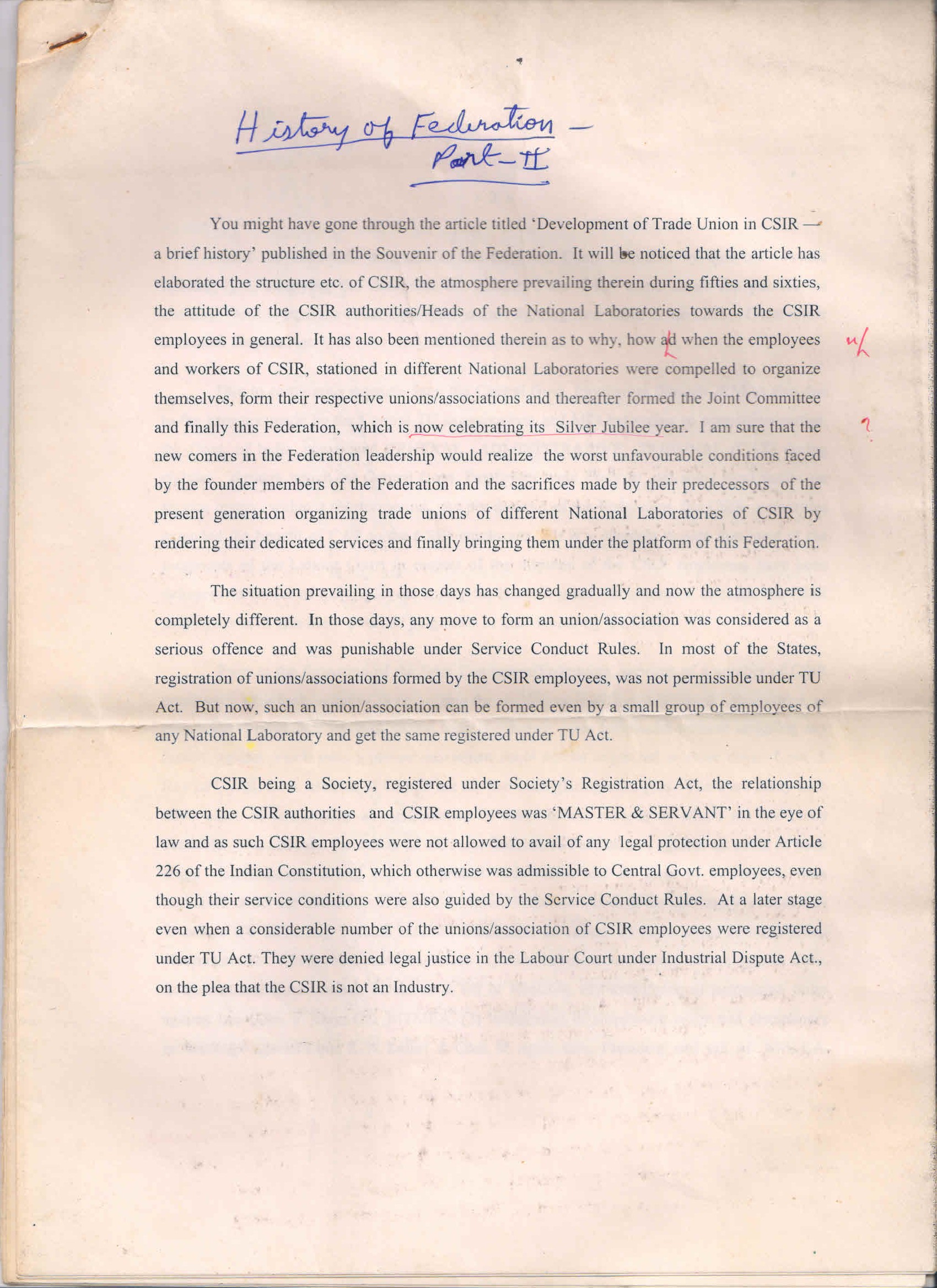
1
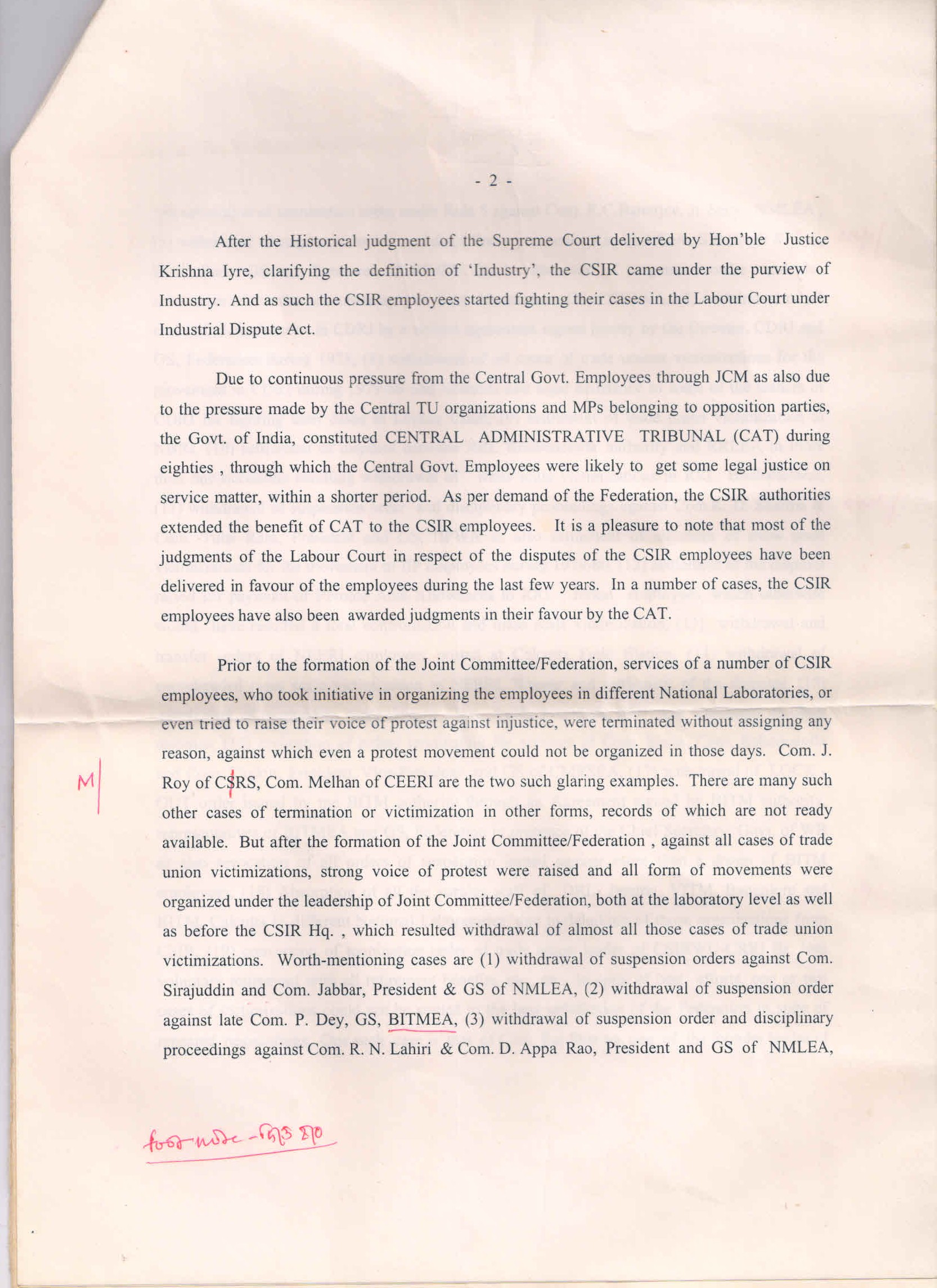
2
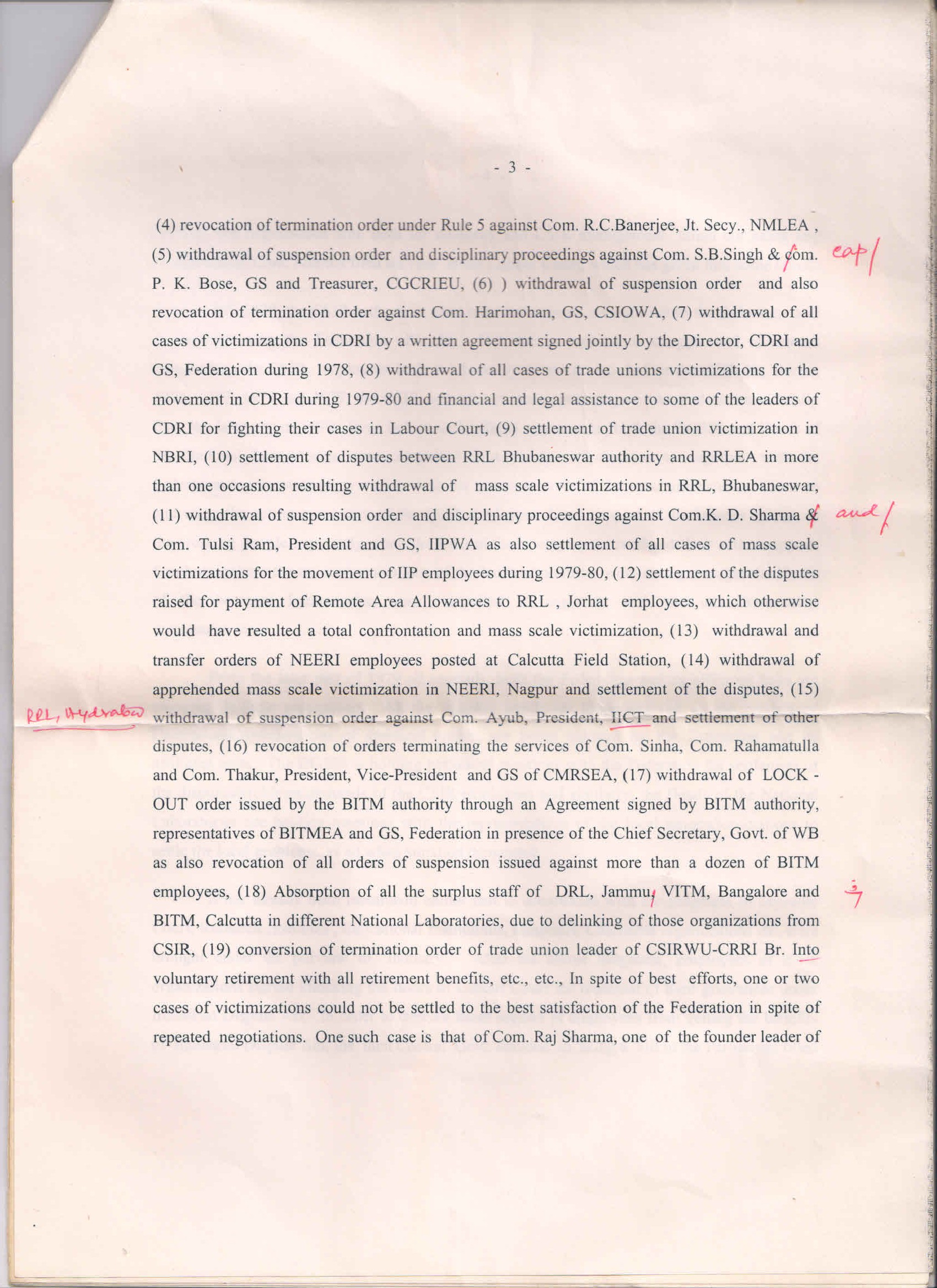
3
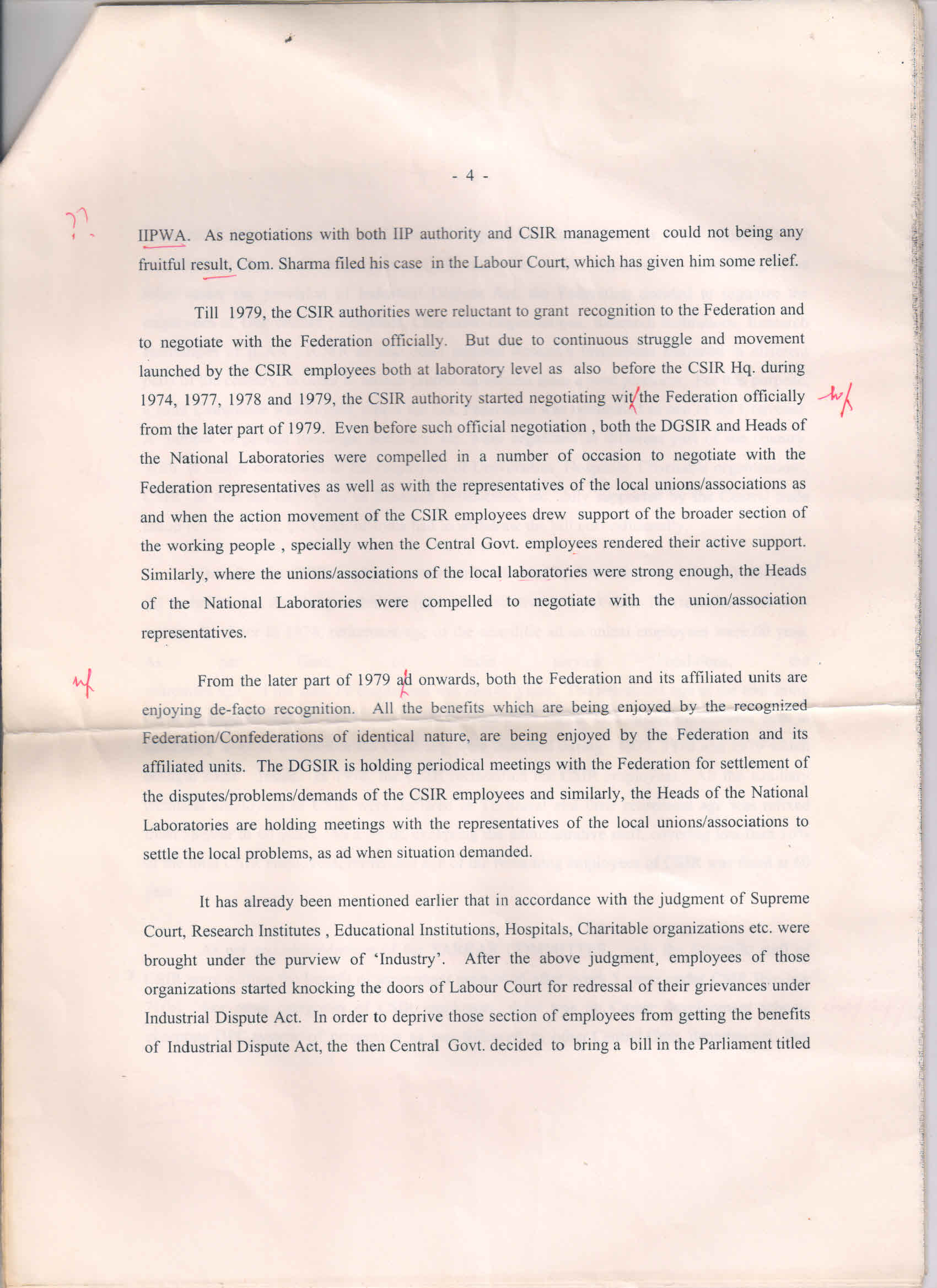
4

5
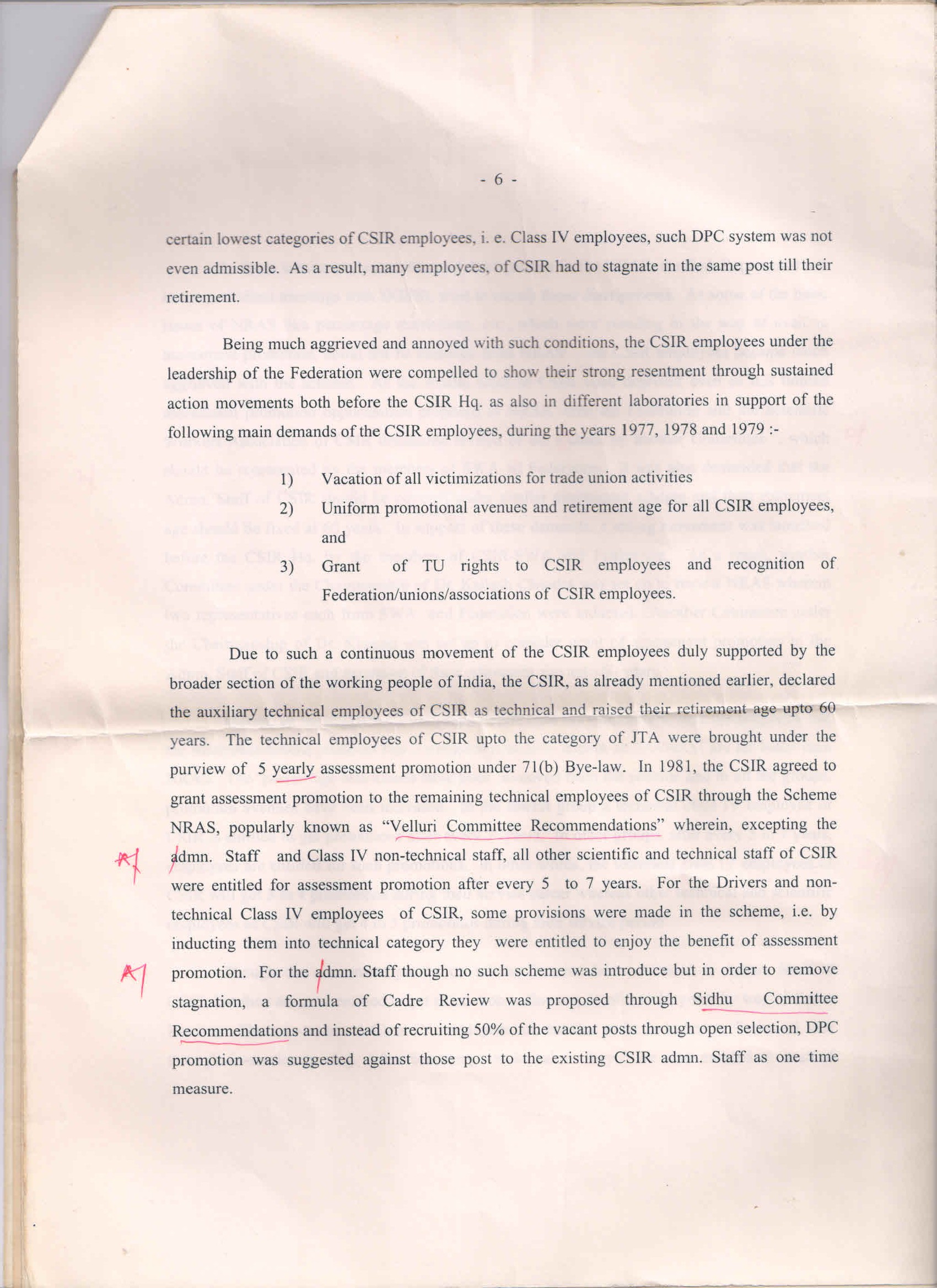
6
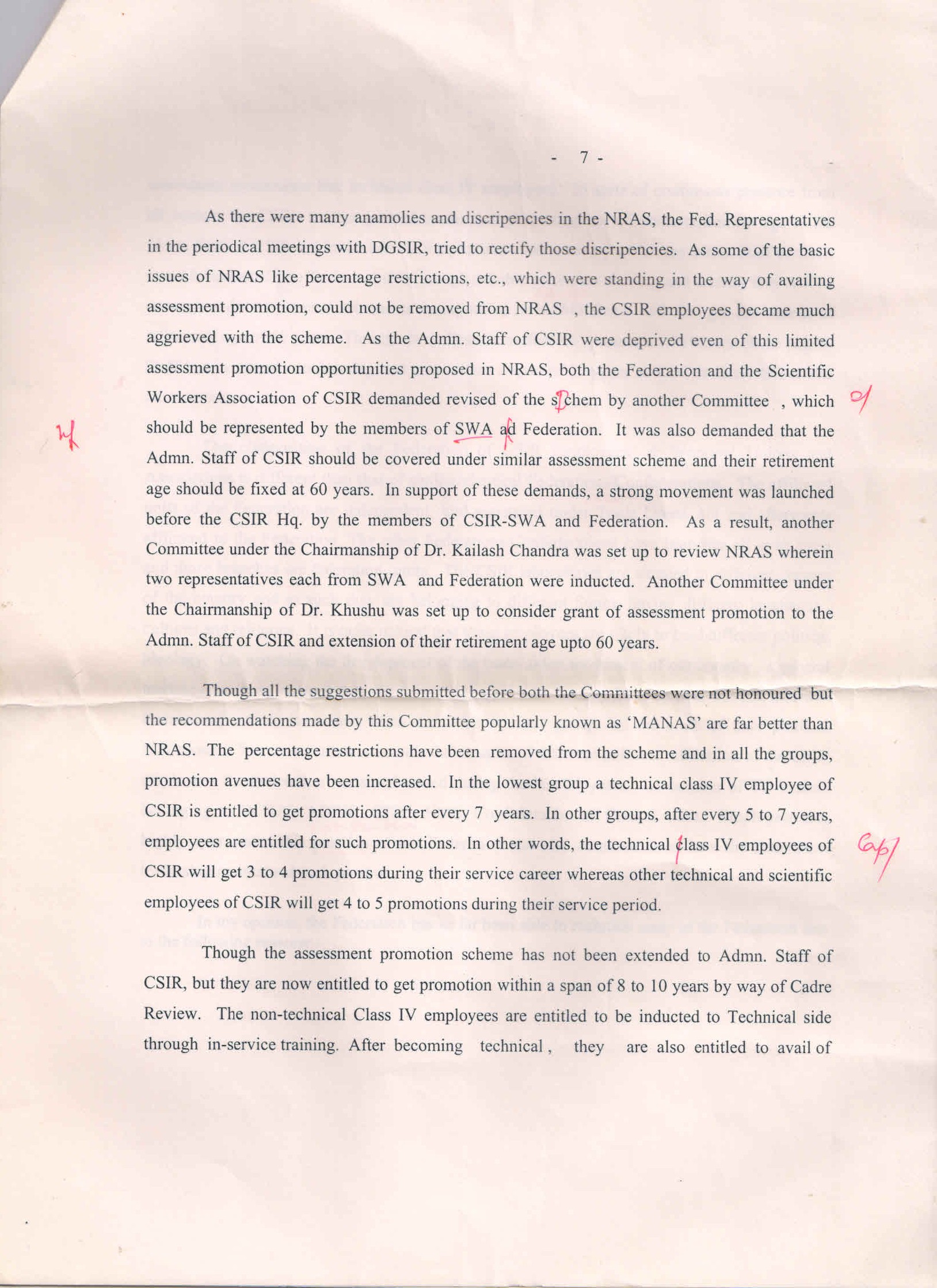
7

8
9
Although the first Annual Conference of the Federation of CSIR Employees & Workers’ Unions & Associations (CSIR Federation) was held in 1972, till 1980/1981 it was a simple and low affair. Only after the DGCSIR accorded de facto recognition in the form of providing office space, providing notice boards, permissions to hold conferences in the premises of the labs/institutes, etc. to the affiliated units of the Federation, things changed dramatically. The DGCSIR also time and again used to circulate instructions to all the Directors/Administrative Heads to hold discussions with the local representatives. With all these, in a few labs, the Directors never used to hold discussions and provide necessary infrastructure to the local units. As there was lack of strength/unity in these labs, these representatives used to knock the doors of the Federation for redressal of their grievances and to see to it that the facilities are provided.
In these Annual Conferences between 1981 and 1998, the respective Directors/ Administrative Heads used to provide all the facilities for holding the Conferences besides making them as semi-official. The inauguration of the Conferences was held in front of the Directors and all staff members of the respective labs/institutes. The Director would also be one of the Chief Guests besides other eminent invitees like MLAs/MPs, Veteran Trade Unionists, etc. Invariably the Directors used to host atleast one day’s breakfast, lunch and dinner to all the delegates of the Conferences. Flag marches within and across the Institutes used to held exhibiting the intense unity of the Federation and its affiliated units [A Video of 23rd Annual Conference of Federation, held at CBRI-Roorkee – The inaugural function – is included in this website]. All the Conferences were held for a period of 3 days. On the first day, besides inauguration, a cultural programme was also being held by the host affiliated unit. On all the three days, threadbare/lengthy/healthy/volatile/militant/sometimes unwanted discussions were held between the delegates comprising of representatives from all its affiliated units numbering between 25-35. Besides, in all these conferences, Souvenir used to be released by the Chief Guests during the inaugural function. This Souvenir consisted of interesting and noted Articles written by the delegates/staff members of CSIR/veteran Trade Unionists/WC Members of the Federation/Affiliated units, etc. Besides, this Souvenir used to carry advertisements of many labs/institutes highlighting their aims & objectives. Needless to mention, these advertisements are printed in the Souvenir on a fixed tariff. Depending on the capacity of the local unit, advertisements were collected from the local industries and business giants also. Through this Souvenir / Advertisements, the funds for the local units used to be generated.
Besides discussions, on the 3rd day of the Conference, elections used to be held. One unique feature of these elections is that, since 1986 till 1998, there were two rival groups – One headed by Mr. K.D.Sharma and another by Mr. V.K. Mago. The clash for the President was invariably between Mr. K.D.Sharma and Mr. V.K. Mago. For all other posts different representatives used to contest. The General Secretary’s position was held specifically by Mr. B.K. Roy (Till 1992), Mr. Abhijit Majumdar (Till 1993) and Mr. N. Suresh Prasad (from 1993 till the collapse of the Federation ie. 2012). Till the retirement of Mr. KD in 2002, Mr. Abhijit was the Joint Secretary; and after retirement Mr. Abhijit was the President (Till his retirement 2006) and afterwards Mr. S.K.Bhattacharya was the President (Till his retirement in 2010). During this period, only 1 or 2 years, ie. between 1998-1999, Mr. V.K. Mago became the President and Mr. Nilamani Das became General Secretary, and for other positions his group members were nominated like Mr. G. Sudhakaran, Mr. Clement Bernard, etc. One unpardonable mistake that the KD Sharma group did was, handing over the leadership to V.K. Mago & his group, which ultimately led to the collapse of the Federation.
One notable aspect of the discussions during the Conferences was that on the second and third day, the discussions (and elections) used to stretch to the next day early morning (5.00 AM / 6.00 AM).
Origin and Scope: The All-India Association of CSIR Employees (AIACE) erstwhile Federation of CSIR Employees’ and Workers’ Unions and Associations, has been in existence for the past 33 years and is functioning at the Central level as the sole bargaining agency representing all the non-gazetted staff members. At present, it has 36 affiliated units/branches (registered under the Indian Trade Union Act of 1926) in various CSIR Labs/Institutes spread throughout the country. The AIACE was accorded de facto / ad hoc recognition by the then DGCSIR from 1979 onwards. Besides holding periodical meetings both by DGCSIR and Directors at Central/Local levels, all the facilities such as providing office rooms/notice boards, granting special CL and TA/DA to the office bearers/WC members, etc. to the AIACE and its units were extended by CSIR authorities till January 1999. A highlighting feature of AIACE is that it is a non-political TU organization, wherein only the serving non-gazetted staff members could become the members and could hold the positions of Office Bearers and Working Committee Members including the post of President.
Activities: The AIACE/Federation has always been a symbol of peace and tranquility, with a possible very few exceptions wherein it had to overlook the spirit of cordial relationship and resort to protest movements. Many vital issues, for the past 20 years (till January 1999), have been discussed across the table with various past Director-Generals and got them settled. Needless to mention, these past DGs though never uttered in their speeches or lectures the key words such as passion, compassion and innovation including the lip statement “I will give blood for the CSIR and its staff members”, were by far the great eminent and illustrious personalities who practiced in deeds and thoughts. The AIACE/Fed. not only did it work for the welfare of the CSIR staff members, but also contributed immensely to the cause of CSIR particularly in its moments of crisis. The CSIR which was termed as white elephant by a group of Parliamentarians in late 1980s was very toughly resisted by the staff members under the banner of Federation and SWA. The much needed inputs were provided by both Federation and SWA to CSIR in order to protect it. Besides, the former DGs nominated Federation/SWA representatives to various official Committees including the Committees which framed personnel/promotion policies to its Scientists/Engineers & other S&T/Admn. staff members, Eg. NRAS, IRAS, MANAS, Khushoo, etc.
Important Facts relating to CCS(RSA) Rules-1993 and blatant Violation of these Rules by the former DGCSIR: The CCS(RSA) Rules-1993 were implemented by Government of India and the same were adopted by the Governing Body of CSIR in the year 1999. The AIACE/Federation, prima facie, did not accept these rules on only one ground that CSIR is an Industry as per the judgement delivered by the CAT, Principal Bench, New Delhi and Supreme Court in 1978, and hence urged for the Trade Union rights to be guaranteed to the staff members of CSIR. Later, when the Supreme Court vide its judgement dated 18.07.2000, declared Ineffective the order of the Full Bench CAT, Principal Bench (New Delhi), the AIACE wholeheartedly accepted these rules. Since then, several requests were made to the incumbent DGCSIR to accord recognition to AIACE strictly as per CCS(RSA) Rules, but to of no avail.
Instead of adopting the CCS(RSA) Rules-1993 in toto as like adopting various other statutory rules, the CSIR has totally altered these Rules much to the disadvantage of the CSIR employees and great advantage to the CSIR Management and its Directors, and have implemented them in CSIR. As per CCS(RSA) Rules, the following provisions have been enunciated very clearly :
Several Ministries/Departments have adopted these rules in its totality and have granted recognitions to the respective Associations at Central levels. For eg. the All-India CGHS Employees’ Association, All-India Passport Employees’ Association, etc. have all been accorded recognition at Central Level by the concerned Ministries/Departments and have facilitated for formation of branches at local levels. Copies of the letters of recognition have long back been provided to former DGCSIR several times.
The Hon’ble Supreme Court in its historic judgement dated 18.04.2002 has declared CSIR as a "State", signaling CSIR to be a Central Government Organization. In this judgement the SC has ensured that the “employees of CSIR would not only have the right not to be discriminated against but also protection against any arbitrary or irrational act of the Management”. In both letter and spirit, the CSIR has blatantly discriminated AIACE with that of the Service Associations of other CG Organizations like All-India CGHS employees’ Association, All-India Passport Employees’ Association, etc. wherein the concerned Ministries/Departments have already granted recognition to them at the central level. Therefore, it is mandatory on the part of the CSIR to implement these CCS(RSA) Rules-1993 in its totality.
On the other hand, the DGCSIR in a bid to totally destroy this AIACE/Federation at the Central level has violated the guidelines contained in these CCS(RSA) Rules, and started granting recognition (categorywise) to a few newly formed local based Associations, which are either Director patronage Associations or those Associations who do not even fulfil the minimum strength of 15% of members. The AIACE which has been existing for the past 30 years is being totally ignored much to the chagrin of a sizeable majority of the staff members of CSIR. The CSIR in writing has communicated that “formation of a Service Association at the Central Level in the present structure of AIACE/Federation is not advisable”, which is very much against the CCS(RSA) Rules-1993. Besides this judgement, the Supreme Court in its another judgement dated 12.5.2002, has clearly held that the "Employer or the Management of any Institute is bound to hold discussions with un-recognized Employees' Associations also even if they have lesser number of members to settle their individual problems related to the service matters & other matters”.


+91 9448604160
nspprasad@yahoo.com+91 9432152451
mavijit.com@gmail.comWebsite prepared and matter compiled by N. Suresh Prasad (President, CFTRI Employees' Union / General Secretary of CSIR Federation / Retired Private Secretary, C.F.T.R.I, Mysuru) with inputs from Abhijit Majumdar (Founder Member of the Federation / General Secretary of CSIR Federation / President, CFRI Employees' Association / Retired Technical Officer, CFRI, Dhanbad)

 9448604160
 nspprasad@yahoo.com